How long will a power station run a refrigerator?
Updated September 30, 2026.
Refrigerators draw about 100–700 W while running and up to 2,900 W for a moment as the motor starts; the top of that range is an older or bigger unit. It cycles on and off, so a typical one uses about 2,000 watt-hours a day, about 84 W on average. A “1000 W” station is not a 1 kWh station: watts say what it can run at once, watt-hours how long. Check both on the label. A 1 kWh station runs it about 10 hours.
A 2 kWh station runs it about 20 hours.
That is the middle of our range for this appliance. Yours may use less or a lot more: the range, the assumptions and every unit we track are below. Hours are hours of use on one full charge, counting about 85% of the battery as usable.
Hours on our three refrigerator picks, and on a freezer
These are the 3 stations we pick for a fridge, from a 3.1 kWh unit to a 3.8 kWh one. Each cell is hours on one full charge. A freezer uses less than a fridge, so it runs longer on the same battery.
| Appliance | Average draw | 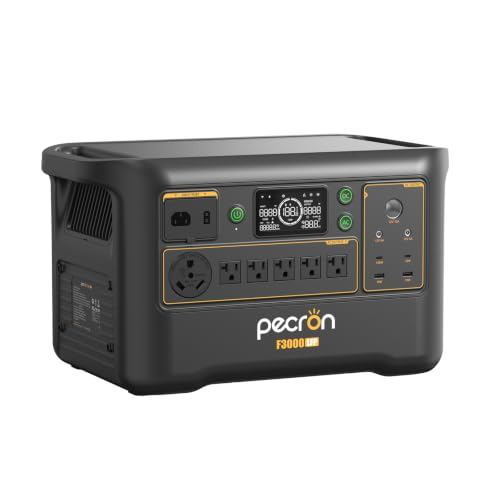 PECRON F3000LFP PECRON F3000LFP2,611 Wh usable $899 at Amazon | 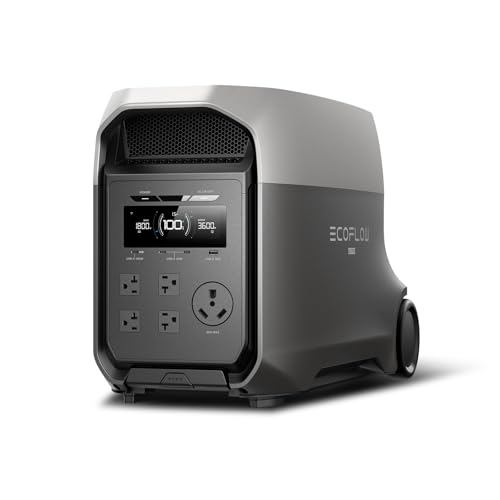 EcoFlow DELTA 3 Ultra (3072Wh) EcoFlow DELTA 3 Ultra (3072Wh)2,611 Wh usable $1,349 at Amazon | 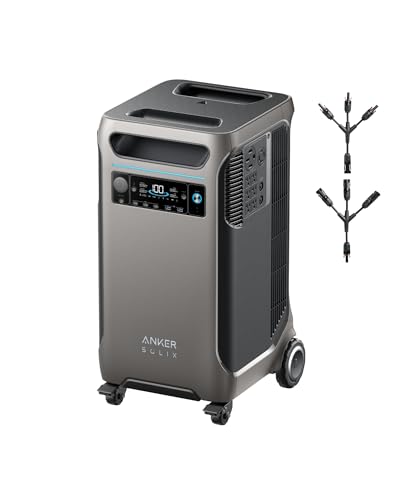 Anker SOLIX F3800 Anker SOLIX F38003,264 Wh usable $1,980 at Amazon |
|---|---|---|---|---|
| A typical fridge (our middle figure) | 84 W | about 31 h | about 31 h | about 39 h |
| A hard-working fridge (old, warm room, door opened often) | 350 W | about 7.5 h | about 7.5 h | about 9.3 h |
| An efficient fridge (new, cool room) | 20 W | about 131 h | about 131 h | about 163 h |
| Chest freezer (ENERGY STAR certified)1 | 25 W | about 106 h | about 106 h | about 133 h |
| Upright freezer (ENERGY STAR certified)2 | 45 W | about 58 h | about 58 h | about 72 h |
| A typical chest freezer (our middle figure) | 52 W | about 50 h | about 50 h | about 63 h |
Hours = usable battery / average draw. Usable is 85% of the maker’s rated capacity. Freezer figures from ENERGY STAR are for certified, efficient units; an older freezer, or one opened often, uses more. All 3 picks publish a peak output above the 2,900 W a hard-starting fridge compressor can pull. Prices checked October 3, 2026. Why these three: best portable power station for a refrigerator.
- ENERGY STAR: freezers, read September 30, 2026: “An ENERGY STAR certified chest freezer uses about 215 kWh of electricity and costs about $30 per year to run”
- ENERGY STAR: freezers, read September 30, 2026: “an ENERGY STAR certified upright freezer uses about 395 kWh of electricity and costs about $60 per year to run”
Hours of use by battery size
| Battery (nameplate) | Typical | Hard-working unit | Efficient unit |
|---|---|---|---|
| 500 Wh | about 5.1 h | 1.2 h | 21 h |
| 1,000 Wh | about 10 h | 2.4 h | 42 h |
| 2,000 Wh | about 20 h | 4.9 h | 85 h |
| 3,000 Wh | about 30 h | 7.3 h | 128 h |
| 5,000 Wh | about 51 h | 12 h | 212 h |
Hours = 85% of the nameplate battery divided by average watts. Typical uses about 84 W; hard-working 700 W on 50% of the time; efficient 100 W on 20% of the time. The station must also start it: see which units can, below.
How much battery a typical one needs
| Outage | Battery needed, typical |
|---|---|
| 12 hours | about 1,200 Wh |
| 24 hours | about 2,400 Wh |
| 3 days | about 7,100 Wh |
Nameplate watt-hours, so the 85% usable share is already counted. Past a day, most plans add solar or a generator rather than a bigger battery.
The range behind that
A refrigerator uses about 100–700 watts while running , and needs up to 2,900 watts for a split second when it starts. Over 24 hours it uses roughly 480–8,400 watt-hours.
Buy for the higher number in each range. 61 of the 73 products we track can run it. For example, the Zendure SuperBase V6400 would run it for 16–274 hours of use, from a hard-working unit to an efficient one.
Sized in a full plan
This load is part of a plan we ran against every unit we track, with picks: The best portable power stations for home backup; The best portable generators for home backup; Which EcoFlow DELTA 3? The whole family, judged against one plan; EcoFlow DELTA 3 vs DELTA 3 Plus: which one to buy; The home-backup class: DELTA Pro 3, SOLIX F3800, Explorer 5000 Plus and the rest; Which power station will run your refrigerator?; The best backup power for a well pump; Anker SOLIX F3800 vs F3800 Plus: the real differences; Jackery Explorer 1000 v2 vs 1000 Plus: the expandable one or the cheaper one.
The numbers behind that
A fridge compressor cycles on and off. It is not drawing power continuously, which is why energy use is far lower than the running-watt figure suggests. Opening the door in a warm house pushes duty toward the high end.
What it draws while it is actually on. The high end is an older or larger unit, not a typical one.
The momentary surge when a motor or compressor kicks in. Undersized systems fail here, not on running watts.
How much of the hour it is actually drawing power. This is what turns running watts into energy.
Multiply the battery capacity you are considering by roughly 0.85 to compare like with like.
Usually plugs in
Most units plug into a normal socket. If yours is wired into the wall instead, treat it as the case below.
Check this yourself
Read the nameplate inside the door frame. A 2005 side-by-side and a 2024 Energy Star unit differ by several times.
What can run it
Hours of use on one full charge: typical, then the range from a hard-working unit to an efficient one. “Starts it” means the peak output covers even a hard-starting one; “may not start a hard-starting one” means it covers the lower end of the starting range only.
| Product | Continuous | Peak | Starts it? | Hours of use |
|---|---|---|---|---|
| Zendure SuperBase V6400 | 3,800W | 5,000W | starts it | about 65h 16–274h |
| OUKITEL P5000 Pro | 3,600W | not listed by the maker | maker gives no peak figure | about 52h 12–218h |
| Jackery Explorer 5000 Plus | 7,200W | 14,400W | starts it | about 51h 12–214h |
| Zendure SuperBase V4600 | 3,800W | 5,000W | starts it | about 47h 11–196h |
| EcoFlow DELTA Pro 3 | 4,000W | 8,000W | starts it | about 42h 9.9–174h |
| Honda EU3000iS Inverter Generator | 2,800W | 3,000W | starts it | fuel-dependent |
| FIRMAN WH03242 Dual-Fuel Inverter | 3,200W | 4,000W | starts it | fuel-dependent |
| Champion 201444 5500W Inverter | 4,000W | 5,500W | starts it | fuel-dependent |
What will not work, and why
8 of 73 products cannot run this.
- OUKITEL P800 — 435Wh usable cannot cover a 24-hour outage for these loads, which need 480–8,400Wh. It would carry the plan for roughly 0.6h before recharging.
- BLUETTI AC50B — 381Wh usable cannot cover a 24-hour outage for these loads, which need 480–8,400Wh. It would carry the plan for roughly 0.5h before recharging.
- Jackery Explorer 300D — 245Wh usable cannot cover a 24-hour outage for these loads, which need 480–8,400Wh. It would carry the plan for roughly 0.3h before recharging.
- Anker SOLIX C300 — 245Wh usable cannot cover a 24-hour outage for these loads, which need 480–8,400Wh. It would carry the plan for roughly 0.3h before recharging.
- Jackery Explorer 300 v2 — 245Wh usable cannot cover a 24-hour outage for these loads, which need 480–8,400Wh. It would carry the plan for roughly 0.3h before recharging.
- BLUETTI Elite 30 V2 — 245Wh usable cannot cover a 24-hour outage for these loads, which need 480–8,400Wh. It would carry the plan for roughly 0.3h before recharging.
How many watts does a chest freezer use?
A chest freezer draws about 80–500 W while running and up to 2,200 W for a moment as it starts. It runs 15%–45% of the time, so a typical one averages about 52 W: about 1,200 Wh a day. The hours on a battery are in the table above.