Anker SOLIX F3800 vs F3800 Plus: the real differences
Two power stations that share a name, a product page, a battery and an inverter. What separates them is the way power gets in, and the price.
Buy the Anker SOLIX F3800: at $1,980 it costs less than the Anker SOLIX F3800 Plus at $2,400, and it carries the same battery and the same continuous and surge output as the Anker SOLIX F3800 Plus in the makers’ figures. The Plus is not a trim level of the base unit but a separate machine, with its own model number and its own manual, rebuilt around its inputs. Buy the Plus only if you need its inputs. Against this plan both land on the same verdict, Clears the best case only.
The Amazon links on this page are affiliate links: if you buy through one we may earn a commission, at no extra cost to you. It does not change which units are picked. How that works.
| Model | Usable | Output | Typical day | Per usable kWh | Price | |
|---|---|---|---|---|---|---|
| The one you can buy | 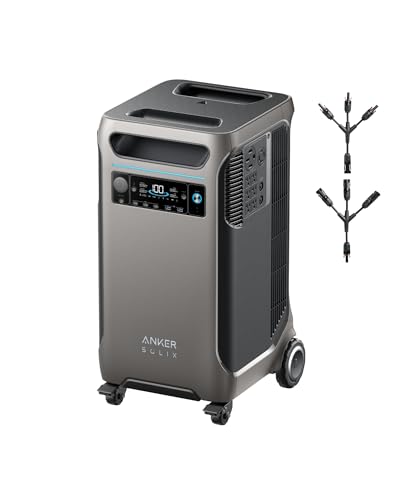 Anker SOLIX F3800 Anker SOLIX F3800 | 3,264 Wh | 6,000 W | one charge | $607 | $1,980 at Amazon |
| The Plus | 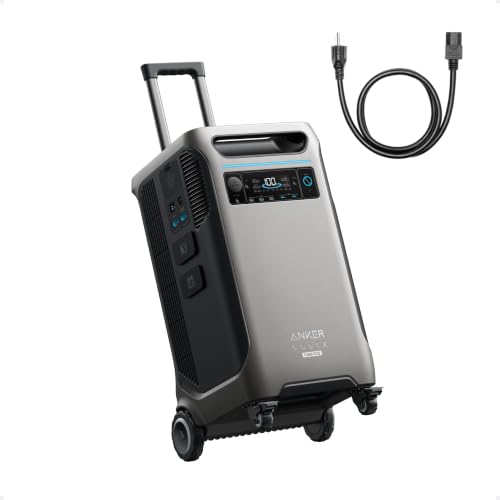 Anker SOLIX F3800 Plus Anker SOLIX F3800 Plus | 3,264 Wh | 6,000 W | one charge | $735 | $2,400 at Amazon |
Who this is for
You have settled on Anker's biggest wheeled box and found two of them on one product page with almost the same name, and you want to know whether the Plus is a newer version of the thing you were about to buy or a different machine. It is a different machine. This page is about what changed and which one to order.
Side by side, from the makers’ own documents
“Not listed by the maker” means the maker pages we read do not state it. It is not a zero, and we never fill it from a sibling model. “No verified listing” means no Amazon listing for the bare unit matched the bare unit by name, battery and output yet.
| Model | Battery | Continuous output | Peak output | Weight | Solar input | Expandable | Warranty | Chemistry | Verified listing |
|---|---|---|---|---|---|---|---|---|---|
| Anker SOLIX F3800 | 3,840 Wh | 6,000 W | 9,000 W | 132 lb (60.0 kg) | 2,400 W | Up to 6 add-on batteries, 26.88 kWh added capacity | 5 years | LiFePO4 | $1,980 |
| Anker SOLIX F3800 Plus | 3,840 Wh | 6,000 W | 9,000 W | 137 lb (62.0 kg) | 3,200 W | Up to 6 extra batteries, 26,880 Wh total capacity | 5 years | LiFePO4 | $2,400 |
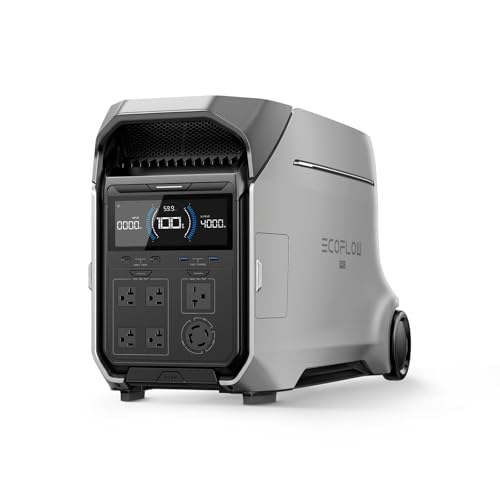 EcoFlow DELTA Pro 3 EcoFlow DELTA Pro 3 | 4,096 Wh | 4,000 W | 8,000 W | 114 lb (51.5 kg) | 2,600 W | Up to 2 extra batteries via one expansion port | 5 years | LiFePO4 | $2,799 |
Against the same plan
A refrigerator, Wi-Fi, a few LED lights and phone charging for 24 hours, sized on the harder end of every range.
The refrigerator is almost the whole number, and the reason the answer is a range: a newer one in a cool kitchen needs 918 watt-hours across 24 hours, an older one opened all day needs 10,416. Wi-Fi, lights and phones barely register. Capacity does not separate these two: same battery, same output, the same 3,060 watt surge covered, both reading Clears the best case only, both among the 39 of 73 units that cover the best case while none covers the worst.
The difference is the inputs. The base takes solar on Anker's XT-60 connector; the Plus moves to MC4, so existing Anker panels need adapters despite the page's compatibility claims. The Plus splits solar across two ports with a combined ceiling above the base unit's single rating, and one review outlet reports the base struggled to reach even its rated solar figure while the Plus charges at its rated speed on standard MC4 panels. The same outlet reports the Plus alone falls well short of its headline combined charging rate, which needs two expansion batteries, and flags the TT-30R outlet as rated below the amperage its name implies, enough to leave an RV hookup stuttering.
| Model | Covers the energy | Carries the running load | Clears the surge | Typical day | Verdict |
|---|---|---|---|---|---|
| Anker SOLIX F3800 | best case only | worst case | Refrigerator/freezer: starts it | one charge | Clears the best case only |
| Anker SOLIX F3800 Plus | best case only | worst case | Refrigerator/freezer: starts it | one charge | Clears the best case only |
| EcoFlow DELTA Pro 3 | best case only | worst case | Refrigerator/freezer: starts it | one charge | Clears the best case only |
Where the energy goes, load by load
| Load | Hours | Running watts | Duty cycle | Energy | Share of worst case |
|---|---|---|---|---|---|
| Refrigerator/freezer | 24 | 100–700 | 20–50% | 480–8,400 Wh | 81% |
| Wi-Fi router and modem | 24 | 15–40 | 100% | 360–960 Wh | 9% |
| Phone charging and small USB devices | 24 | 10–40 | 20–60% | 48–576 Wh | 6% |
| A few LED lights | 8 | 15–80 | 25–75% | 30–480 Wh | 5% |
Energy = running watts × duty cycle × hours, at each end of the range. The right-hand end of every row is what the plan is sized on.
The one you can buyAnker SOLIX F3800
The one most people should buy
$1,980 at Amazon, October 3, 20263,840 Wh (3,264 usable)6,000 W continuous9,000 W peak132 lb
The Anker SOLIX F3800 is the one with the fewest open questions: a verified listing at $1,980, and the same battery, continuous rating and surge rating our data gives the Anker SOLIX F3800 Plus. It reads Clears the best case only against this plan, exactly as the Plus does, so nothing about the day you are buying for argues for spending more. It suits the person who already owns Anker panels on the older connector, or who has no solar at all and wants the confirmed price.
Our rule: the cheapest unit that covers a typical day of this plan (2,900 Wh).
One charge covers a typical day of this plan (about 2,900 Wh). A hard-working refrigerator/freezer may need up to about 10,400 Wh.
Price as of October 3, 2026; the listing we verified as the bare unit.
A refrigerator, Wi-Fi, a few LED lights and phone charging for 24 hours:
- Energyonly in the best case
- Running loadyes, even in the worst case
- Starting surgeRefrigerator/freezer: starts it
What you give up: What you give up is the Plus's input work: the second solar port and the higher combined ceiling, the standard solar connector, and a manual that documents bypass and generator switching where the base unit's record leaves pass-through and idle draw blank.
Owner reports and tester figures are on the model page.
Figures from ankersolix.com, captured August 12, 2026; recall screen: no published recall names this exact model (screened 2026-10-01) (how we screen, CPSC).
The PlusAnker SOLIX F3800 Plus
The Plus
$2,400 at Amazon, October 3, 20263,840 Wh (3,264 usable)6,000 W continuous9,000 W peak137 lb
The Anker SOLIX F3800 Plus is the same battery and the same output with the inputs rebuilt: MC4 solar across two ports, a higher combined ceiling, and bypass and generator behaviour written down in the manual rather than left blank. It reads Clears the best case only against this plan, the same as the base, so it is not a bigger unit, it is a better-fed one. What it gives up is money: at $2,400 it costs more than the base at $1,980. It suits someone buying panels new, or wiring a generator in.
Price as of October 3, 2026; the listing we verified as the bare unit.
A refrigerator, Wi-Fi, a few LED lights and phone charging for 24 hours:
- Energyonly in the best case
- Running loadyes, even in the worst case
- Starting surgeRefrigerator/freezer: starts it
What you give up: Money: $2,400 against $1,980 for the base.
Owner reports and tester figures are on the model page.
Figures from ankersolix.com, captured September 29, 2026; recall screen: no published recall names this exact model (screened 2026-10-01) (how we screen, CPSC).
Past the first day
Stretch the same loads to three days (72 hours) of the same loads and neither is in the conversation: 2,754 watt-hours at the efficient end, 31,248 at the hard end, against two batteries that needed the best case to cover one day. Past the first evening the question is not which box but how you refill it.
Buying it right
A search for these models returns bundles, sibling models and the same unit under two prices. We link only a listing whose own title states the bare unit with its exact battery and output. Match the model number on the label to this page. How we check a listing.
- Anker SOLIX F3800: we link the bare unit, checked October 3, 2026. We turned down 9 other listings (bundles, sibling models, repeats); see which and why.
- Anker SOLIX F3800 Plus: we link the bare unit, checked October 3, 2026. We turned down 9 other listings (bundles, sibling models, repeats); see which and why.
What this page can’t promise
Nothing here was tested by us. The specifications are Anker's own, off its product pages and manuals, and where those disagree we say so rather than quote the better number. No owner forum thread turned up for either unit, so everything labelled owner experience comes from a few hands-on review sites, and one of them, on which socket the Plus uses for EV charging, contradicts Anker's own manual and stays unresolved.
One gap: the manual we obtained for the base documents the 230-volt version of the same hardware, so its charging-input rows were set aside and only cell- and firmware-level rows used. Whether the Plus is worth the extra money depends on whether you will use its inputs.
Questions people ask
Is the F3800 Plus the same as the F3800?
No, though the headline numbers are identical. They are two different machines, the base being Anker's A1790 and the Plus the A1790P, with the same battery capacity, the same continuous output and the same surge rating in the makers’ figures, sharing one product page, which is how the confusion starts. What changes is the input side: the solar connector, the number of solar ports, the combined charging ceiling and the documentation behind bypass charging. Confirm the model number on the box before you pay.
How long will either one run my fridge?
Through the best case of this plan and not the worst. For a refrigerator, Wi-Fi, a few LED lights and phone charging for 24 hours, a newer fridge that cycles lightly lands near 918 watt-hours and either unit covers it; an older one in a warm kitchen, opened all day, lands near 10,416 and neither does. That is the size of the class rather than a fault in these two: 39 of the 73 units we track clear the best case, and not one clears the worst.
Can I use F3800 expansion batteries with the Plus?
Yes. The Plus's own manual names the same Anker SOLIX BP3800 pack the base unit takes, and allows the same maximum number of them, so a pack bought for one is not stranded by the other. Two things reviewers report: the connection cables are long and floppy rather than a clean stack, and on the Plus the packs are also what lifts its combined charging rate to the headline figure, so an extra battery buys you input speed as well as capacity.
I already own Anker solar panels. Which one should I buy?
The base Anker SOLIX F3800, unless you are ready to re-cable. Anker's panels for the base unit use its own XT-60 connector, and the Plus moved to MC4, so existing Anker panels and leads need adapters to reach it even though the product page talks about MC4 compatibility. If you are buying panels new, that flips: MC4 is what most third-party panels use, and one review outlet reports the Plus actually reaches its rated solar speed where the base fell short of its own figure.
Other plans we sized
- Home backup
- Camping and road trips
- CPAP
- Portable generators
- The home-backup class: DELTA Pro 3, SOLIX F3800, Explorer 5000 Plus and the rest (comparison)
- Refrigerator
- Sump pump
- Furnace
- Well pump
- Power station or generator: which do you actually need?
- How to connect a power station to your house
- Solar panels for a power station: how many, and how long
- Expansion batteries: what an extra battery for a power station actually does
Anker SOLIX F3800Our pick
$1,980 at Amazon