Jackery Explorer 5000 Plus
The Jackery Explorer 5000 Plus is a 5,040 Wh power station on wheels with 7,200 W at 120 V and 240 V. On one charge it runs a typical fridge about 51 hours and an older furnace blower about 24 hours. Both, plus Wi-Fi, lights and phones: about 14 hours.
$735 per usable kWh at Amazon prices checked October 3, 2026 ($3,149 for 4,284 usable Wh). Its Jackery Battery Pack 5000 Plus had no bare-pack listing on Amazon when we checked. How we work it out
Amazon links here are affiliate links: we may earn a commission, at no cost to you. It does not change our numbers. How that works.
Price checked October 3, 2026; Amazon shows today’s price. This is the listing we matched to the bare unit, not a bundle.
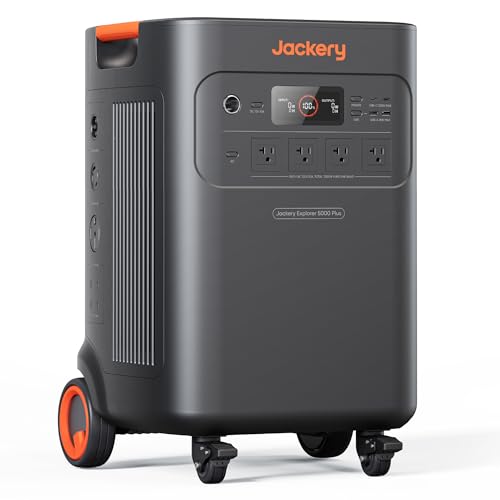
5,040 Wh battery (4,284 usable)7,200 W output14,400 W peak
- Extra batteries
- Up to 5 Battery Pack 5000 Plus, to 30,240 Wh. None sold alone on Amazon. Details
- Solar
- 4,000 W, but only from 135–450 V panel strings; 1,200 W from ordinary panels. In plain words
- House
- Jackery Smart Transfer Switch, or a 240 V transfer switch. How it connects
- As a UPS
- 0 ms in Online UPS mode; under 20 ms otherwise. Details
- Wall charge
- 1,750 W, about 3.5 hours
- Weight
- 134.5 lb, on wheels
We compile maker specs and published tests; we did not test this unit.
Explorer 5000 Plus vs DELTA Pro 3 vs Anker F3800
- Most in one box: the Explorer 5000 Plus. 5,040 Wh and 7,200 W. DELTA Pro 3: 4,096 Wh, 4,000 W. F3800: 3,840 Wh, 6,000 W.
- Lowest cost per usable kWh: the Anker SOLIX F3800. $1,980 on Amazon, $607 per usable kWh, against $735 for the Explorer 5000 Plus. With one extra battery it drops to $579 ($3,780 in all).
- DELTA Pro 3 or Explorer 5000 Plus? The Jackery holds 944 Wh more and costs less per usable kWh ($735 against $804). The DELTA Pro 3 weighs less (113.5 lb against 134.5 lb). Its extra battery is sold alone on Amazon; the Jackery’s is not.
The same numbers as a table
| Setup | Wh | Essentials + furnace | Amazon | Per usable kWh |
|---|---|---|---|---|
| Anker SOLIX F3800 | 3,840 | 10 hours | $1,980 | $607 |
| Anker SOLIX F3800 Plus | 3,840 | 10 hours | $2,400 | $735 |
| EcoFlow DELTA Pro 3 | 4,096 | 11 hours | $2,799 | $804 |
| Explorer 5000 Plus | 5,040 | 14 hours | $3,149 | $735 |
| F3800 + 1 extra battery | 7,680 | 21 hours | $3,780 | $579 |
| DELTA Pro 3 + 1 extra battery | 8,192 | 22 hours | $4,598 | $660 |
Prices checked October 3, 2026. The full side-by-side table.
It is the whole-home pick on our Jackery page (most output). For a fridge, Wi-Fi and lights, the HomePower 3000 costs less per usable kWh ($517 against $735), but it has no 240 V.
How long it runs each appliance
A typical fridge runs about 51 hours. Fridge, Wi-Fi, lights and phones, no furnace: about 33 hours. Left on with nothing plugged in, it uses about 50 W (Jackery), about 1.2 kWh a day.
Chart: hours for 8 common appliances
The same numbers as a table
| Appliance | Typical average draw | Hours on one charge |
|---|---|---|
| Fridge | 84 W | about 51 h |
| Furnace blower, older (PSC) | 182 W | about 24 h |
| Furnace blower, variable-speed (ECM) | 132 W | about 32 h |
| CPAP | 55 W | about 78 h |
| Sump pump | 136 W | about 32 h |
| Well pump | 65 W | about 66 h |
| Wi-Fi router and modem | 24 W | about 175 h |
| Laptop | 52 W | about 82 h |
All 16 appliances, with starting watts and ranges
| Appliance | Running / starting | Starts it? | Typical | Range |
|---|---|---|---|---|
| Wi-Fi router and modem | 15–40 W | starts it | about 175h | 107–286h |
| Phone charging and small USB devices | 10–40 W | starts it | about 618h | 178–2,142h |
| A few LED lights | 15–80 W | starts it | about 286h | 71–1,142h |
| Laptop and monitor | 45–150 W | starts it | about 82h | 29–238h |
| CPAP | 30–100 W | starts it | about 78h | 43–143h |
| Refrigerator/freezer | 100–700 W
starts at up to 2,900 W |
starts it | about 51h | 12–214h |
| Chest freezer | 80–500 W
starts at up to 2,200 W |
starts it | about 82h | 19–357h |
| Gas-furnace blower | 400–1,200 W
starts at up to 3,500 W |
starts it | about 24h | 5.1–36h |
| Sump pump | 700–1,500 W
starts at up to 4,500 W |
starts it | about 32h | 8.2–122h |
| Well pump | 700–2,000 W
starts at up to 6,000 W |
starts it | about 66h | 14–306h |
| Window air conditioner | 500–3,250 W
starts at up to 7,200 W |
starts it | about 5.9h | 1.6–21h |
| Microwave | 800–1,800 W | starts it | about 2 hours of running time | short bursts |
| Coffee maker | 700–1,500 W | starts it | about 3 hours of running time | short bursts |
| Television | 40–250 W | starts it | about 78h | 17–357h |
| Garage door opener | 300–800 W
starts at up to 1,800 W |
starts it | about 5 hours of running time | short bursts |
| 12 V compressor fridge (camping) | 25–110 W
starts at up to 320 W |
starts it | about 231h | 78–685h |
Typical is the middle of our range for that appliance. The range runs from a hard-working unit to an efficient one. Microwave, coffee maker and garage door show minutes of running time, because they run in short bursts.
How it connects to your house
Jackery Smart Transfer Switch. A small subpanel with breakers built in (The Solar Lab). It feeds up to 12 circuits at 120 V or 6 at 240 V (Jackery), from one or two 5000 Plus units only (Jackery; Jackery). With UPS on in the app it switches in 20 ms; without it, about 5 seconds (Jackery; Jackery). It is the only way to charge at 240 V (The Solar Lab). Alone it cost $999 at Amazon (checked October 3, 2026). Amazon also sells the station and switch together for $3,989 (checked October 3, 2026), against $4,148 bought apart.
A 240 V transfer switch. Its 30 A twist-lock (L14-30R) outlet is 120/240 V (manual), so a generator inlet and transfer switch work. Jackery also sells a 240 V, 50 A manual switch for it (Jackery). Which transfer switch fits.
An electrician installs either one (Jackery). Never plug a power station into a wall outlet to feed the house. All ways to connect.
Questions buyers ask
Which extra battery fits?
The Battery Pack 5000 Plus, 5,040 Wh each (Jackery). Five fit, 30,240 Wh in all: Jackery’s 30.24 kWh (Jackery). We found no buyable Amazon listing for the bare pack on October 3, 2026. It comes in a 10 kWh bundle with the station and switch: $6,429 on October 3, 2026, $750 per usable kWh. Jackery’s “60 kWh” (Jackery) is two full stations on the Smart Transfer Switch: 60,480 Wh. Packs add hours, not power (GearDiary).
How much solar can it take?
Two kinds of input. Your panels’ voltage decides which one you use.
- High-voltage input: up to 4,000 W. It needs 135–450 V (Jackery; Jackery). That means a long string of panels wired in series, like a roof array. Jackery says a full 4,000 W array refills it in about 1.7 hours (Jackery).
- Low-voltage inputs: up to 1,200 W. Two ports for ordinary portable panels, 16–60 V (Jackery). One port takes 600 W, both 1,200 W (Jackery). Four Jackery SolarSaga 200 W panels refill it in about 9 hours (Jackery). Real panels give less than their rating. Which panels fit.
Does it have 240 V?
Yes. The twist-lock L14-30R and the 14-50 outlet give 120/240 V, up to 7,200 W (manual; manual). The 14-50 looks like a 50 A RV outlet, but The Solar Lab notes it supports 30 A service (The Solar Lab). While it charges from the wall, the 240 V outlets are off (Jackery).
Can it work as a UPS?
Yes. Online UPS mode switches in 0 ms, on the 120 V outlets, up to 30 A (Jackery; Jackery). The default Backup UPS mode takes under 20 ms, up to 12 A (Jackery; Jackery).
How long does it take to charge from the wall?
About 3.5 hours, at up to 1,750 W from a 120 V, 15 A outlet (Jackery; Jackery).
Can it run central air or a well pump?
Jackery says it can run even a 5-ton air conditioner (Jackery). The Solar Lab could not start a 10,000 W-surge one (The Solar Lab), but ran 8,000–9,500 W loads for 20–30 seconds (The Solar Lab). GearDiary runs its well pump on it (GearDiary). Well pump starting watts.
How heavy is it?
134.5 lb (61 kg), 16.5 x 15.5 x 25 in (manual), on wheels with a sturdy sliding handle (The Solar Lab).
What is the warranty?
Five years (manual), plus a paid 2-year extension from Jackery (Jackery).
What testers found
We do not test units ourselves. These testers did.
- The Solar Lab measured about 58 W of idle draw (The Solar Lab). It stayed very quiet under heavy load (The Solar Lab). Complaints: no built-in light (The Solar Lab), a solar input door that does not fold back (The Solar Lab), and no pre-drilled holes in the switch panel (The Solar Lab).
- GearDiary ran its well house on the station and switch. The app needs better documentation (GearDiary).
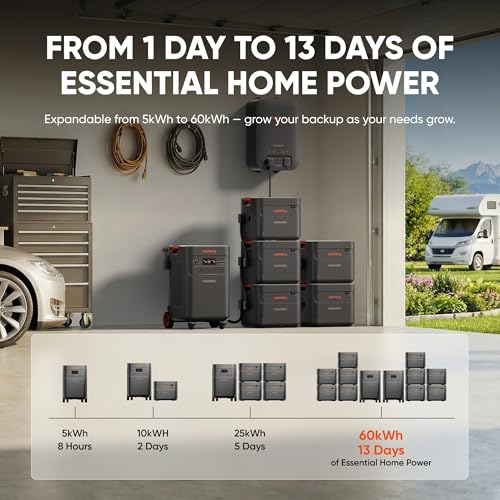
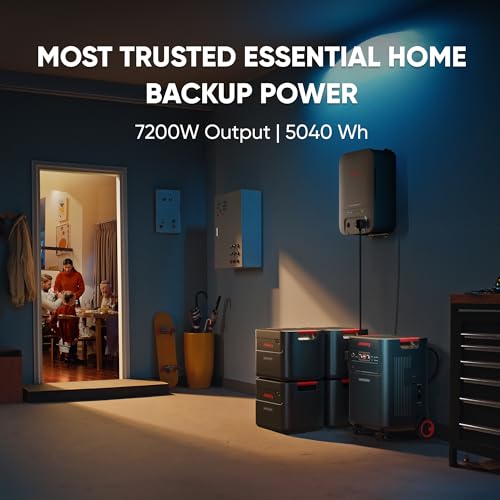
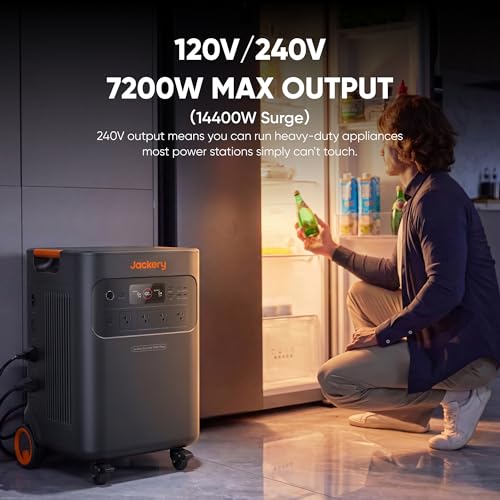
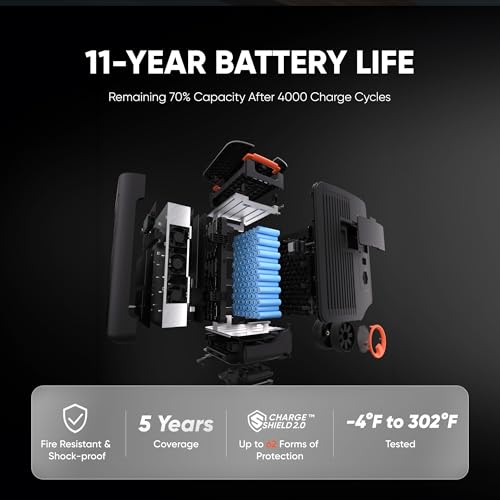
Photos from the Amazon listing we link. Some are Jackery’s own graphics.
Specifications
Manual: Explorer 5000 Plus user manual (PDF). Model JE-5000A (Jackery).
All 15 specifications, with sources
- Model
- JE-5000A Jackery
- Battery
- 5,040 Wh LiFePO4 (about 4,284 Wh usable) Jackery
- Output
- 7,200 W at 120/240 V; 14,400 W surge Jackery
- Outlets
- One L14-30R and one 14-50 (120/240 V); four 120 V 20 A in two 3,600 W pairs; 2 USB-C (100 W); 2 USB-A (18 W); car outlet manual
- Solar
- 4,000 W at 135–450 V; 1,200 W at 16–60 V on two ports Jackery
- Wall charge
- 1,750 W from 120 V, 15 A; about 3.5 h Jackery
- Extra batteries
- Up to 5 Battery Pack 5000 Plus (30,240 Wh) Jackery
- UPS switchover
- 0 ms (Online UPS); under 20 ms (Backup UPS) Jackery
- Idle draw
- 50 W standby (Jackery) Jackery
- Fan noise
- 30 dB or less (Jackery) Jackery
- Weather rating
- Not waterproof or dustproof Jackery
- Battery life
- 4,000 cycles to 70% manual
- Runs in
- 5–113°F; charges at 32–113°F manual
- Size and weight
- 16.5 x 15.5 x 25 in; 134.5 lb (61 kg) manual
- Warranty
- 5 years; 2-year paid extension from Jackery manual
Buying the right one
We link the bare unit (ASIN B0DFGLG35L). “Solar Generator 5000 Plus” listings add panels. The kit with two 200 W panels cost $3,729, $18 less than the same parts bought apart. Not the same as the Jackery Explorer 2000 Plus (a similar name, a different model: 2,043 Wh, 3,000 W).
Recall check: on October 1, 2026 the CPSC recall database listed no Jackery recall (CPSC). Check the CPSC recall search before you buy.
Sources: 8 pages, read October 1, 2026
Jackery Explorer 5000 Plus page; Jackery help center: Explorer 5000 Plus basic information; Jackery Explorer 5000 Plus user manual (PDF); Jackery Smart Transfer Switch page; The Solar Lab: Explorer 5000 Plus review; GearDiary: Explorer 5000 Plus and Smart Transfer Switch review; Jackery Battery Pack 5000 Plus page; CPSC recall database, search for Jackery. Amazon prices checked October 3, 2026 (stations), October 3, 2026 (extra batteries) and October 3, 2026 (switch). Hours of use follow our method: typical appliance draws and 85% of the battery size.
Every Jackery model: which Jackery to buy · best power station for home backup.
Judged in: Which Jackery power station should you buy? (every Jackery model compared); The home-backup class: DELTA Pro 3, SOLIX F3800, Explorer 5000 Plus and the rest.