EcoFlow DELTA Pro 3
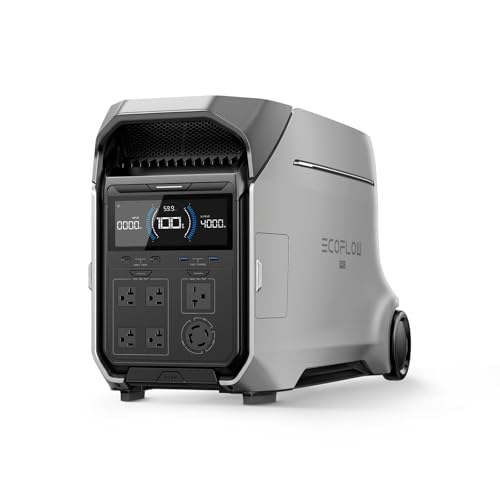
The EcoFlow DELTA Pro 3 is a 4,096 Wh home-backup battery on wheels with 4,000 W of outlets at 120 V or 240 V. On one charge it runs a typical fridge about 42 hours and an older furnace blower about 19 hours. Both, plus Wi-Fi, lights and phones: about 11 hours.
4,096 Wh battery (3,482 usable)4,000 W output8,000 W peak113.5 lb, on wheels
$804 per usable kWh at Amazon prices checked October 3, 2026 ($2,799 for 3,482 usable Wh). Each added EcoFlow DELTA Pro 3 Smart Extra Battery: $517 per usable kWh. How we work it out
Amazon links here are affiliate links: we may earn a commission, at no cost to you. It does not change our numbers. How that works.
Price checked October 3, 2026; Amazon shows today’s price. This is the listing we matched to the bare unit, not a bundle.
- Extra batteries
- Up to 2 DELTA Pro 3 Smart Extra Batteries, 4,096 Wh each: 12,288 Wh in all. How far it goes
- Solar
- Up to 2,600 W: 1,600 W high-voltage input plus 1,000 W low-voltage input. Panels
- 120 V / 240 V
- Both, but not at the same time. What runs on 240 V
- House panel
- Inlet box and transfer switch, or EcoFlow’s automatic Smart Home Panel 2. How it connects
- Wall charge
- 1,800 W from a 120 V outlet; testers took about 3 hours to fill it.
Not the older DELTA Pro or the bigger DELTA Pro Ultra: DELTA Pro 3 vs DELTA Pro Ultra.
How long it runs each appliance
One at a time, on one charge: a CPAP about 64 hours, a sump pump about 26 hours, a window air conditioner about 4.8 hours. It can start every appliance we track.
Chart: hours for 8 common appliances
The same numbers as a table
| Appliance | Typical average draw | Hours on one charge |
|---|---|---|
| Fridge | 84 W | about 42 h |
| Furnace blower, older (PSC) | 182 W | about 19 h |
| Furnace blower, variable-speed (ECM) | 132 W | about 26 h |
| CPAP | 55 W | about 64 h |
| Sump pump | 136 W | about 26 h |
| Well pump | 65 W | about 54 h |
| Wi-Fi router and modem | 24 W | about 142 h |
| Laptop | 52 W | about 67 h |
All 16 appliances, with starting watts and ranges
| Appliance | Running / starting | Starts it? | Typical | Range |
|---|---|---|---|---|
| Wi-Fi router and modem | 15–40 W | starts it | about 142h | 87–232h |
| Phone charging and small USB devices | 10–40 W | starts it | about 503h | 145–1,741h |
| A few LED lights | 15–80 W | starts it | about 232h | 58–928h |
| Laptop and monitor | 45–150 W | starts it | about 67h | 23–193h |
| CPAP | 30–100 W | starts it | about 64h | 35–116h |
| Refrigerator/freezer | 100–700 W
starts at up to 2,900 W |
starts it | about 42h | 9.9–174h |
| Chest freezer | 80–500 W
starts at up to 2,200 W |
starts it | about 67h | 15–290h |
| Gas-furnace blower | 400–1,200 W
starts at up to 3,500 W |
starts it | about 19h | 4.1–29h |
| Sump pump | 700–1,500 W
starts at up to 4,500 W |
starts it | about 26h | 6.6–99h |
| Well pump | 700–2,000 W
starts at up to 6,000 W |
starts it | about 54h | 12–249h |
| Window air conditioner | 500–3,250 W
starts at up to 7,200 W |
starts it | about 4.8h | 1.3–17h |
| Microwave | 800–1,800 W | starts it | about 116 minutes of running time | short bursts |
| Coffee maker | 700–1,500 W | starts it | about 2 hours of running time | short bursts |
| Television | 40–250 W | starts it | about 64h | 14–290h |
| Garage door opener | 300–800 W
starts at up to 1,800 W |
starts it | about 4 hours of running time | short bursts |
| 12 V compressor fridge (camping) | 25–110 W
starts at up to 320 W |
starts it | about 188h | 63–557h |
Typical is the middle of our range for that appliance. The range runs from a hard-working unit to an efficient one. Microwave, coffee maker and garage door show minutes of running time, because they run in short bursts.
How far it goes with extra batteries
The same numbers as a table
| Setup | Wh | With furnace | No furnace | Amazon price |
|---|---|---|---|---|
| DELTA Pro 3 alone | 4,096 | 11 hours | 27 hours | $2,799 on Amazon: $804 per usable kWh |
| + 1 extra battery | 8,192 | 22 hours | 54 hours (2 days) | $4,598 on Amazon: $660 per usable kWh |
| + 2 extra batteries (the most) | 12,288 | 34 hours | 80 hours (3 days) | $6,397 on Amazon: $612 per usable kWh |
| 3 units + 6 extra batteries | 36,864 | 101 hours (4 days) | 241 hours (10 days) | $20,790 on Amazon with the panel, plus installation |
No furnace (about 130 W): 27 hours on one charge. Prices: station checked October 3, 2026, extra battery October 3, 2026, panel October 3, 2026. One unit takes two extra batteries at most (manual); three units on Smart Home Panel 2 reach 36,864 Wh, which EcoFlow calls 36 kWh (EcoFlow). EcoFlow’s “up to 48 kWh” also counts three EcoFlow Smart Generators (EcoFlow). Batteries alone stop at 36,864 Wh.
How it connects to your house
Its 30 A twist-lock outlet (L14-30R) feeds an inlet box and transfer switch (EcoFlow). The outlet is rated 16.7 A (manual), so the station sets the limit. Smart Home Panel 2 switches by itself and takes up to three units (EcoFlow); it must be installed (EcoFlow).
- Manual switch kit: the Reliance Controls 310CRK ten-circuit transfer switch kit has the switch, inlet box and L14-30 cord in one box. $475 at Amazon
- Automatic panel: EcoFlow Smart Home Panel 2. $1,599 at Amazon
Amazon prices checked October 3, 2026. A transfer switch is required (manual). Use a licensed electrician and a permit. Which switch fits · All ways to connect.
Questions buyers ask
The manual: EcoFlow DELTA Pro 3 user manual (PDF).
Can you add an extra battery?
Yes, up to two. The DELTA Pro 3 Smart Extra Battery holds 4,096 Wh, the same as the station. It cost $1,799 on Amazon on October 3, 2026: $517 per usable kWh, against $804 for the station. Two of them bring one unit to 12,288 Wh, about 10.4 kWh usable. The older DELTA Pro Smart Extra Battery fits too (EcoFlow). Extra batteries for every station.
Is it 8,000 watts?
No. 8,000 W is the peak, for a motor starting up. It runs 4,000 W all the time, or 6,000 W for heaters with X-Boost turned on (EcoFlow). For more power, two units on EcoFlow’s 50 Amp Hub double the output, up to 33 A in the US (manual). EcoFlow also sells an “8kWh” kit: one station plus one extra battery.
What solar input does it take?
Up to 2,600 W through two inputs (EcoFlow). The high-voltage input takes 30–150 V, up to 1,600 W. The low-voltage input takes 11–60 V, up to 1,000 W (manual). Keep each string’s open-circuit voltage (Voc) under the limit. Bob Vila saw 320–335 W from one 400 W panel (Bob Vila). Robb Sutton got about 1,100 W from three 400 W panels on a cloudy day (Robb Sutton). Which panels fit.
Can it run 240 V appliances?
Yes. The 240 V button turns on the L14-30 twist-lock outlet and a 6-20R 240 V outlet, and turns the 120 V outlets off (EcoFlow). So it gives 120 V or 240 V, not both at once.
How long does it take to charge?
From a normal 120 V outlet it takes up to 1,800 W, so a full charge takes at least 2.3 hours. Testers measured about 3 hours (The Solar Lab; OutdoorGearLab). EcoFlow’s “80% in 50 minutes” uses faster sources together, up to 7,000 W (EcoFlow).
Is it waterproof?
Only the battery pack inside is IP65 (manual). The unit is IP20 (EcoFlow), so use it indoors or outside under cover (EcoFlow).
How heavy is it? Does it have wheels?
113.5 lb, with wheels and a pull-out handle (manual). Bob Vila’s tester used a cart on grass and gravel (Bob Vila) and two people to load it (Bob Vila).
Can it work as a UPS?
Yes, with a 10 ms switchover (manual). One tester’s desktop PC still shut off during a switch (Robb Sutton). Plugged into the wall, it passes through about 1,800 W (CleanTechnica).
DELTA Pro 3 vs DELTA Pro Ultra
The Ultra is EcoFlow’s bigger, two-piece system. Pick the DELTA Pro 3 for one box that rolls and up to 12 kWh. Pick the DELTA Pro Ultra if you need more than 4,000 W at once or more than 12 kWh on one unit. Their batteries do not mix (EcoFlow).
- Battery. Pro 3: 4,096 Wh in one box. Ultra: 6,144 Wh per battery, plus a separate inverter.
- Most on one unit. Pro 3: 12,288 Wh (2 extra batteries). Ultra: 30 kWh (5 batteries).
- Most in a system. Pro 3: 36 kWh (3 units). Ultra: 90 kWh.
- Output. Pro 3: 4,000 W; 8,000 W peak. Ultra: 7,200 W; 10.8 kW peak.
- Solar. Pro 3: 2,600 W. Ultra: 5,600 W.
- Weight. Pro 3: 113.5 lb. Ultra: 70 lb inverter + 111.8 lb battery.
- Switchover. Pro 3: 10 ms. Ultra: under 20 ms; 0 ms on some outlets.
- Weather rating. Pro 3: IP65 battery pack; IP20 unit. Ultra: IP54.
- Price. Pro 3: $2,799 on Amazon, October 3, 2026. Ultra: $4,199 at EcoFlow, October 1, 2026.
Ultra figures from the DELTA Pro Ultra page, read October 1, 2026. Other brands: DELTA Pro 3 vs Anker F3800 vs Jackery 5000 Plus · Expansion batteries for every station · How long a power station runs a refrigerator. Also not the same unit: EcoFlow DELTA 3 Plus (1,024 Wh), EcoFlow DELTA 3 (1,024 Wh), EcoFlow DELTA Pro (3,600 Wh). Read the model name on the unit’s label.
What testers found
We do not test units ourselves. These testers did.
- Bob Vila’s tester used one for two months (Bob Vila). In a camper he measured a fridge at 170–180 W and an air conditioner at 755–780 W (Bob Vila). After Friday night to Sunday morning it still had 18% left (Bob Vila).
- OutdoorGearLab measured 3,790 of 4,096 Wh (OutdoorGearLab), more than the 3,482 Wh we plan on.
- A 3-ton central air conditioner with a soft-start kit still tripped its overload (Robb Sutton).
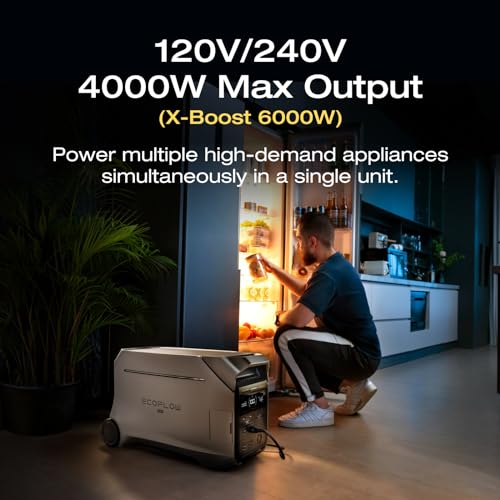
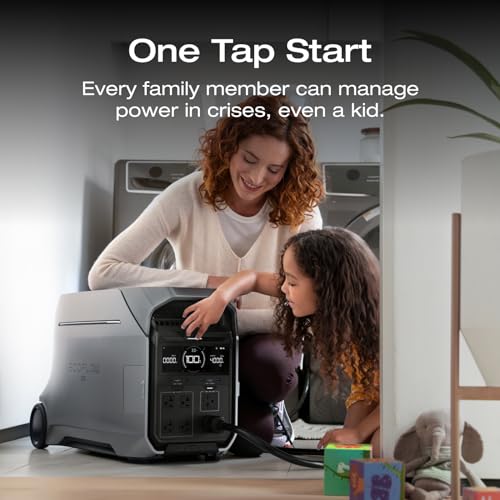
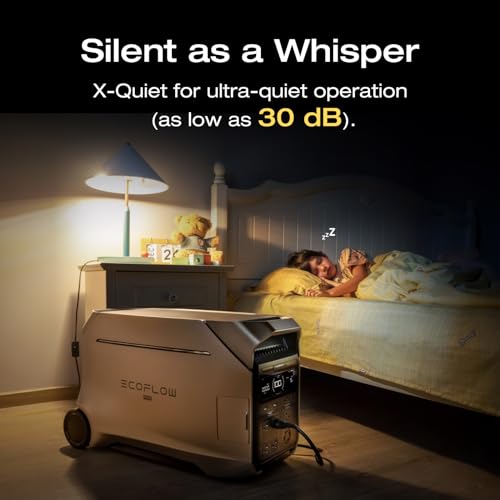
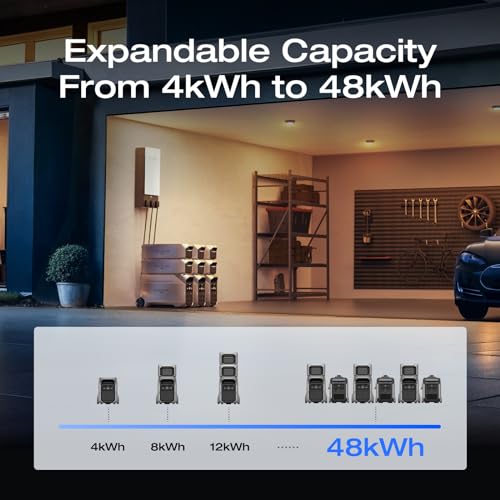
Photos from the Amazon listing we link. Some are EcoFlow’s own graphics.
Specifications
All 12 specifications, with sources
- Battery
- 4,096 Wh LiFePO4 (about 3,482 Wh usable) manual
- Output
- 4,000 W pure sine wave, 120 V or 240 V; 8,000 W peak; 6,000 W with X-Boost EcoFlow
- Outlets
- Four 120 V 20 A; one 30 A RV (TT-30R); one 120/240 V twist-lock (L14-30R, 16.7 A); one 240 V (6-20R); 2 USB-C (100 W); 2 USB-A (18 W); 12 V DC (378 W) manual
- Solar
- 2,600 W in all: 30–150 V up to 1,600 W, and 11–60 V up to 1,000 W manual
- Wall charge
- 1,800 W on 120 V (15 A) manual
- Extra batteries
- Up to 2; 12,288 Wh in all manual
- UPS switchover
- 10 ms manual
- Weather
- Battery pack IP65; unit IP20 manual
- Cycle life
- 4,000 cycles to 80%+ capacity at 25°C (77°F) manual
- Runs in
- 14–113°F; charges at 32–113°F manual
- Size and weight
- 16.16 × 13.43 × 27.28 in; 113.5 lb (51.5 kg) manual
- Warranty
- 5 years (3-year standard warranty plus 2-year extended warranty available upon EcoFlow App registration) EcoFlow
Buying the right one
We link the bare DELTA Pro 3 (ASIN B0D14FMFZD, checked October 3, 2026). Search results also show kits with panels or a battery, and the older DELTA Pro.
Recall check: no CPSC recall names the DELTA Pro 3 (model EFD521) in our screen of September 29, 2026. That cannot clear your own unit. Check its serial number with EcoFlow (EcoFlow recall lookup) or the CPSC recall search.
Listings we did not link, and why
| Listing | Why not |
|---|---|
| EF ECOFLOW Power Station 4096Wh DELTA Pro 3 with 400W Portable Solar Panel | Listing is a bundle (solar panel or kit), not the bare base unit our specifications describe. |
| EF ECOFLOW 12kWh Portable Power Station: DELTA Pro 3 with 2 Extra Batteries | Listing title does not state a capacity, so base-unit identity cannot be confirmed. |
| EF ECOFLOW Portable Power Station 3600Wh DELTA Pro, 120V 3600W AC Output | Listing title does not contain the model name 'DELTA Pro 3'. |
| EF ECOFLOW DELTA Pro 3 Solar Generator 4096Wh with 2X400W Solar Panels | Listing is a bundle (solar panel or kit), not the bare base unit our specifications describe. |
| EF ECOFLOW 8kWh Portable Power Station: DELTA Pro 3 with Extra Battery | Listing is a bundle (solar panel or kit), not the bare base unit our specifications describe. |
Sources: 9 pages, read October 1, 2026
EcoFlow DELTA Pro 3 product page; EcoFlow DELTA Pro 3 user manual (PDF); EcoFlow DELTA Pro Ultra product page; EcoFlow Smart Home Panel 2 page; Bob Vila: EcoFlow DELTA Pro 3 review; Robb Sutton: DELTA Pro 3 review; CleanTechnica: long-term review; OutdoorGearLab review; The Solar Lab review. Amazon prices checked October 3, 2026 (station), October 3, 2026 (extra battery) and October 3, 2026 (transfer equipment). Hours of use follow our method: typical appliance draws and 85% of the battery size.
Judged in: Which EcoFlow power station should you buy? (every EcoFlow model compared); The best portable power stations for home backup; The home-backup class: DELTA Pro 3, SOLIX F3800, Explorer 5000 Plus and the rest; Can a power station run a gas furnace? Yes, with the right hookup; Anker SOLIX F3800 vs F3800 Plus: the real differences (compared).