EcoFlow DELTA 3 Ultra Plus
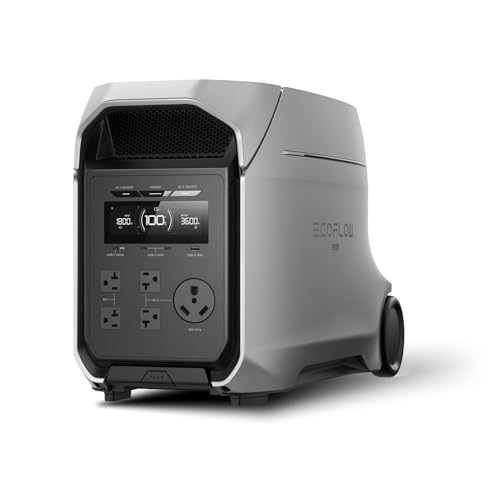
The EcoFlow DELTA 3 Ultra Plus is a 3,072 Wh power station on wheels with 3,600 W of 120 V outlets. On one charge it runs a typical fridge about 31 hours and an older furnace blower about 14 hours. Both, plus Wi-Fi, lights and phones: about 8.4 hours.
3,072 Wh battery (2,611 usable)3,600 W output7,200 W peak
$605 per usable kWh at Amazon prices checked October 3, 2026 ($1,579 for 2,611 usable Wh). How we work it out
Amazon links here are affiliate links: we may earn a commission, at no cost to you. It does not change our numbers. How that works.
Price checked October 3, 2026; Amazon shows today’s price. This is the listing we matched to the bare unit, not a bundle.
- Extra batteries
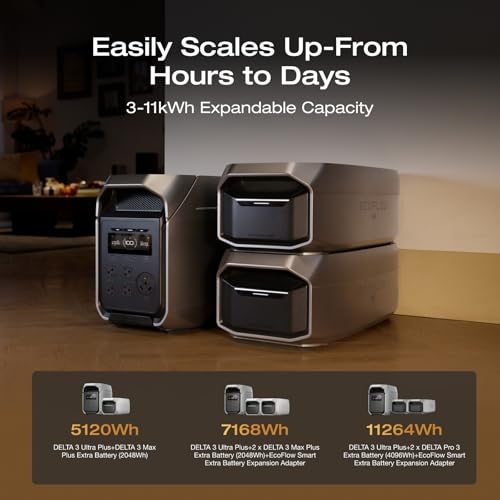
- Up to 2, to 11,264 Wh (EcoFlow’s “11 kWh”). Which ones, priced
- Solar
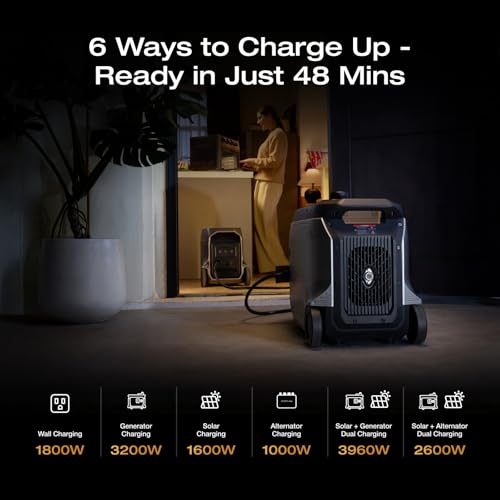
- Up to 1,600 W: two 800 W inputs. Panels
- 240 V
- No. 120 V only. What that rules out
- House
- Inlet box and manual transfer switch. How it connects
- As a UPS
- Switches to battery in under 10 ms. Details
- Weight
- 74.3 lb, on wheels
The plain DELTA 3 Ultra is the same box without extra batteries: which one to buy today.
Ultra Plus, Ultra, DELTA Pro 3 or DELTA 3 Max?
- Not adding batteries? The DELTA 3 Ultra. Same 3,072 Wh battery and 3,600 W output. On October 3, 2026 it cost $1,349 on Amazon, $230 less: $517 per usable kWh against $605. It takes no extra battery and half the solar (800 W) (EcoFlow).
- Adding batteries or big solar? The Ultra Plus. It takes up to two extra batteries, to 11,264 Wh, and 1,600 W of solar. Full size it costs $5,177 on Amazon plus EcoFlow’s adapter: $541 per usable kWh.
- Need 240 V or more than 3,600 W? The DELTA Pro 3. 4,096 Wh and 4,000 W at 120 V or 240 V, $2,799 ($804 per usable kWh). A full DELTA Pro 3 (12,288 Wh) costs $6,397: $612 per usable kWh, more than a full Ultra Plus.
- Is 2 kWh enough? The DELTA 3 Max. $879, $505 per usable kWh. The lowest cost per usable kWh of any EcoFlow on Amazon today. A typical fridge runs about 21 hours. No extra battery. The DELTA 3 Max Plus takes extra batteries and runs 3,000 W, for $1,149 ($660 per usable kWh).
The same numbers as a table
| Setup | Wh | With furnace | No furnace | Amazon | Per usable kWh |
|---|---|---|---|---|---|
| DELTA 3 Max | 2,048 | 5.6 hours | 13 hours | $879 | $505 |
| DELTA 3 Ultra | 3,072 | 8.4 hours | 20 hours | $1,349 | $517 |
| Ultra Plus | 3,072 | 8.4 hours | 20 hours | $1,579 | $605 |
| Ultra Plus + 2,048 Wh battery | 5,120 | 14 hours | 33 hours | $2,478 | $569 |
| DELTA Pro 3 | 4,096 | 11 hours | 27 hours | $2,799 | $804 |
| Ultra Plus + 4,096 Wh battery | 7,168 | 20 hours | 47 hours | $3,378 | $554 |
| DELTA Pro 3 + 1 battery | 8,192 | 22 hours | 54 hours (2 days) | $4,598 | $660 |
| Ultra Plus + 2 × 4,096 Wh* | 11,264 | 31 hours | 74 hours (3 days) | $5,177 | $541 |
| DELTA Pro 3 + 2 batteries | 12,288 | 34 hours | 80 hours (3 days) | $6,397 | $612 |
* Two packs also need EcoFlow’s Smart Extra Battery Expansion Adapter, sold separately and not counted (EcoFlow). Amazon prices checked October 3, 2026. Every EcoFlow model: which EcoFlow to buy.
The Solar Lab found the older DELTA Pro usually cheaper (The Solar Lab). On Amazon on October 3, 2026 it cost $1,899, $320 more than the Ultra Plus. DELTA Pro on the brand page.
How long it runs each appliance
A typical fridge runs about 31 hours: 7.5 hours for an old one working hard, up to 131 for an efficient one. EcoFlow says 12–24 hours for a 200 W fridge (EcoFlow), but a fridge cycles on and off, so we plan on 84 W. We plan on 2,611 Wh usable; StorageReview measured 2.61 kWh out (StorageReview).
Chart: hours for 8 common appliances
The same numbers as a table
| Appliance | Typical average draw | Hours on one charge |
|---|---|---|
| Fridge | 84 W | about 31 h |
| Furnace blower, older (PSC) | 182 W | about 14 h |
| Furnace blower, variable-speed (ECM) | 132 W | about 20 h |
| CPAP | 55 W | about 48 h |
| Sump pump | 136 W | about 19 h |
| Wi-Fi router and modem | 24 W | about 107 h |
| Laptop | 52 W | about 50 h |
All 14 appliances, with starting watts and ranges
| Appliance | Running / starting | Starts it? | Typical | Range |
|---|---|---|---|---|
| Wi-Fi router and modem | 15–40 W | starts it | about 107h | 65–174h |
| Phone charging and small USB devices | 10–40 W | starts it | about 377h | 109–1,306h |
| A few LED lights | 15–80 W | starts it | about 174h | 44–696h |
| Laptop and monitor | 45–150 W | starts it | about 50h | 17–145h |
| CPAP | 30–100 W | starts it | about 48h | 26–87h |
| Refrigerator/freezer | 100–700 W
starts at up to 2,900 W |
starts it | about 31h | 7.5–131h |
| Chest freezer | 80–500 W
starts at up to 2,200 W |
starts it | about 50h | 12–218h |
| Sump pump | 700–1,500 W
starts at up to 4,500 W |
starts it | about 19h | 5–75h |
| Window air conditioner | 500–3,250 W
starts at up to 7,200 W |
starts it | about 3.6h | 1–13h |
| Microwave | 800–1,800 W | starts it | about 87 minutes of running time | short bursts |
| Coffee maker | 700–1,500 W | starts it | about 104 minutes of running time | short bursts |
| Television | 40–250 W | starts it | about 48h | 10–218h |
| Garage door opener | 300–800 W
starts at up to 1,800 W |
starts it | about 3 hours of running time | short bursts |
| 12 V compressor fridge (camping) | 25–110 W
starts at up to 320 W |
starts it | about 141h | 47–418h |
Typical is the middle of our range for that appliance. The range runs from a hard-working unit to an efficient one. Microwave, coffee maker and garage door show minutes of running time, because they run in short bursts.
How it connects to your house
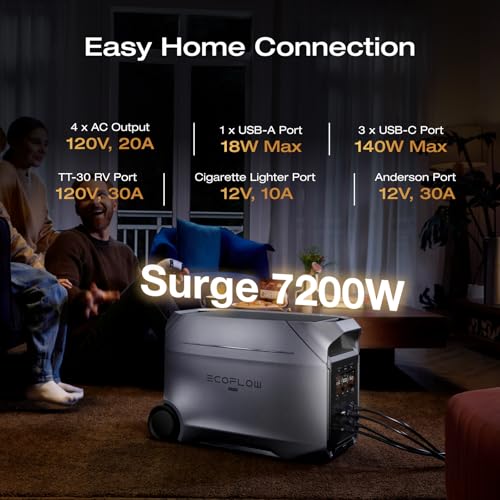
EcoFlow names two ways: a manual transfer switch, sold separately, or an inlet box (EcoFlow). It has a 30 A RV-style outlet (The Solar Lab), and EcoFlow sells it in a bundle with a 125 V, 30 A transfer switch (EcoFlow). It gives 120 V only (manual), so it runs 120 V circuits such as the fridge, lights and a gas furnace blower, not a 240 V well pump or dryer. Smart Output Priority lets you pick which circuits stay on in the app (EcoFlow).
An electrician fits the inlet and switch, with a permit. Never plug it into a wall outlet to feed the house. One quirk for a switch hookup: above 3,600 W the 30 A side shuts off first, even if the overload is on the 120 V outlets (The Solar Lab). All ways to connect · Which switch fits.
Questions buyers ask
Which extra battery fits?
EcoFlow lists four: the DELTA 3 Max Plus, DELTA Pro 3, DELTA 3 Series and DELTA 2 Max Smart Extra Batteries (EcoFlow). It has one battery port; two packs need EcoFlow’s expansion adapter (EcoFlow). Two on Amazon:
- DELTA Pro 3 Smart Extra Battery, 4,096 Wh. One makes 7,168 Wh; two make 11,264 Wh, the “11 kWh” setup (EcoFlow). $1,799: $517 per usable kWh.
- DELTA 2 Max Smart Extra Battery, 2,048 Wh. One makes 5,120 Wh. $899: $516 per usable kWh.
Prices checked October 3, 2026; the station is $605 per usable kWh. All extra batteries.
What solar input does it take?
Up to 1,600 W: two inputs of 800 W each (manual), 11–60 V. The plain Ultra takes 800 W in all. Keep each input’s open-circuit voltage (Voc) under 60 V. It also charges from a car alternator kit at up to 1,000 W (EcoFlow). Which panels fit.
Does it have 240 V?
No. Its outlets are 120 V: four 20 A and one 30 A (manual). The Solar Lab says it is not for someone who needs 240 V (The Solar Lab). For a 240 V well pump, look at the DELTA Pro 3.
Can it work as a UPS?
Yes. Plugged into the wall, it switches to battery within 10 ms (EcoFlow). StorageReview measured 8.25 ms (StorageReview), and AppleInsider’s workstation stayed on (AppleInsider). EcoFlow warns that desktop computers may still turn off (EcoFlow).
How long does it take to charge?
From a wall outlet: 80% in 91 minutes and full in 120 minutes, at up to 1,800 W (EcoFlow). An EcoFlow Smart Generator charges it at up to 3,200 W, and it can start and stop that generator by itself (EcoFlow; EcoFlow).
How heavy is it?
74.3 lb (33.7 kg), on rubber wheels with a suitcase handle (The Solar Lab). The plain Ultra is about 2 lb (1 kg) lighter (EcoFlow).
Can it run a 4,600 W appliance?
Some can. X-Boost runs devices up to 4,600 W, though the rating is 3,600 W (EcoFlow). It lowers the voltage to do it (manual), so the device runs below full power.
Where is the manual?
A copy is posted as a PDF: DELTA 3 Ultra Plus user manual. The model number is EF-DL-H02-3UP (manual).
What testers found
We do not test units ourselves. These testers did.
- The Solar Lab measured about 85% efficiency (The Solar Lab) and about 24 W of idle draw with both outlet sides on (The Solar Lab). It charged at 1,800 W while running about 3,000 W (The Solar Lab), and the fans stayed quiet at full power (The Solar Lab).
- Their complaints: no built-in light (The Solar Lab) and the 30 A overload quirk, which viewers say the app can reverse (The Solar Lab).
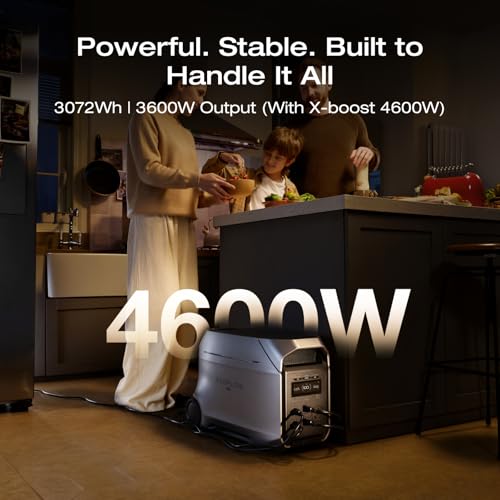
Photos from the Amazon listing we link. Some are EcoFlow’s own graphics.
Specifications
All 14 specifications, with sources
- Model
- EF-DL-H02-3UP manual
- Battery
- 3,072 Wh LiFePO4 at 51.2 V (about 2,611 Wh usable) manual
- Output
- 3,600 W pure sine wave, 120 V only; 7,200 W surge; X-Boost to 4,600 W manual
- Outlets
- Four 120 V 20 A; one 30 A; 1 USB-C (140 W); 2 USB-C (45 W shared); 1 USB-A (18 W); car outlet (126 W); Anderson (378 W) manual
- Solar
- 1,600 W in all: two inputs, 800 W each, 11–60 V manual
- Wall charge
- 1,800 W; 0–80% in 91 min, full in 120 min EcoFlow
- Generator charge
- Up to 3,200 W; auto start/stop with EcoFlow Smart Generators EcoFlow
- Extra batteries
- Yes, to 11 kWh with 2 DELTA Pro 3 Extra Batteries (11,264 Wh) EcoFlow
- UPS switchover
- Under 10 ms EcoFlow
- Weather rating
- IP20 manual
- Battery life
- No cycle count published; EcoFlow estimates about 10 years EcoFlow
- Runs in
- 14–113°F; charges at 32–113°F manual
- Size and weight
- 24.1 × 12.9 × 15.6 in; 74.3 lb (33.7 kg) manual
- Warranty
- 3-year warranty, extendable to 5 years total EcoFlow
Buying the right one
We link the bare DELTA 3 Ultra Plus (ASIN B0FQVG59LV, checked October 3, 2026). Search results also show the plain DELTA 3 Ultra (3072Wh), solar bundles and battery bundles. Check for the word Plus.
Recall check: on October 1, 2026 the CPSC recall database listed one EcoFlow recall, the DELTA Max 2000 (CPSC). None named the DELTA 3 Ultra Plus. That cannot clear your own unit; check the CPSC recall search before you buy.
Listings we did not link, and why
| Listing | Why not |
|---|---|
| EF ECOFLOW Delta 3 Ultra 3072Wh Portable Power Station, 3600W AC Output | Listing title does not contain the model name 'DELTA 3 Ultra Plus'. |
| EF ECOFLOW 3072Wh Power Station DELTA 3 Ultra Plus with 400W Solar Panel | Listing is a bundle (solar panel or kit), not the bare base unit our specifications describe. |
| EF ECOFLOW Portable Power Station DELTA 3 Max Plus, 2048Wh, 3000W Output | Listing title does not contain the model name 'DELTA 3 Ultra Plus'. |
| EF ECOFLOW DELTA 3 Ultra Plus 3072Wh Power Station with 2X220W Solar Panels | Listing is a bundle (solar panel or kit), not the bare base unit our specifications describe. |
| EF ECOFLOW Delta 3 Ultra 3072Wh Solar Generator with 400W Solar Panel | Listing is a bundle (solar panel or kit), not the bare base unit our specifications describe. |
Sources: 7 pages, read October 1, 2026
EcoFlow DELTA 3 Ultra Plus product page; EcoFlow DELTA 3 Ultra Plus and Ultra FAQ; EcoFlow DELTA 3 Ultra Plus user manual (PDF, Home Depot copy); The Solar Lab: DELTA 3 Ultra Plus review; StorageReview: DELTA 3 Max Plus and Ultra Plus review; AppleInsider: DELTA 3 Ultra Plus review; CPSC recall database, search for EcoFlow. Amazon prices checked October 3, 2026. Hours of use follow our method: typical appliance draws and 85% of the battery size.
Judged in: Which EcoFlow power station should you buy? (every EcoFlow model compared); Which EcoFlow DELTA 3? The whole family, judged against one plan.