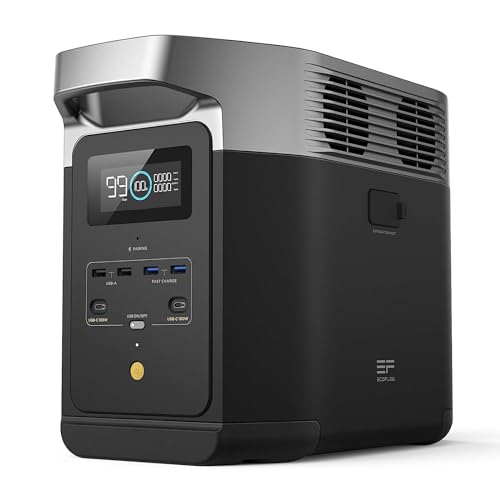
EcoFlow DELTA 2 (EFD330)
The EcoFlow DELTA 2 (EFD330) is a 1,024 Wh portable power station with 1,800 W of outlets. On one charge it runs a typical fridge about 10 hours and an older furnace blower about 4.8 hours.
1,024 Wh battery (870 usable)1,800 W output2,700 W peak
$688 per usable kWh at Amazon prices checked October 3, 2026 ($599 for 870 usable Wh). Each added EcoFlow DELTA 2 Max Smart Extra Battery: $516 per usable kWh. How we work it out
Amazon links here are affiliate links: we may earn a commission, at no cost to you. It does not change our numbers. How that works.
Price checked October 3, 2026; Amazon shows today’s price. This is the listing we matched to the bare unit, not a bundle.
- Extra battery
- Takes one. With a DELTA 2 Max Extra Battery (2,048 Wh) it holds 3,072 Wh. Which pack
- Solar
- Up to 500 W, 11–60 V
- Wall charge
- 1,200 W: 80% in 50 min, full in 80 min
- As a UPS
- Switches to battery in about 30 ms. Not a true UPS. What that means
It may not start a hard-starting fridge or older furnace blower. Not the DELTA 2 Max or a DELTA 3: which DELTA is which.
How long it runs each appliance
The same numbers as a table
| Appliance | Typical average draw | Hours on one charge |
|---|---|---|
| Fridge | 84 W | about 10 h (may not start a hard-starting one) |
| Furnace blower, older (PSC) | 182 W | about 4.8 h (may not start a hard-starting one) |
| Furnace blower, variable-speed (ECM) | 132 W | about 6.6 h |
| CPAP | 55 W | about 16 h |
| Sump pump | 136 W | about 6.4 h (may not start a hard-starting one) |
| Wi-Fi router and modem | 24 W | about 36 h |
| Laptop | 52 W | about 17 h |
One reviewer ran an 18 cu ft fridge for 8–10 hours (Power Station Advisor), close to our figure. A furnace blower is wired in. Running it needs an inlet or transfer switch fitted by an electrician.
All 13 appliances, with starting watts and ranges
| Appliance | Running / starting | Starts it? | Typical | Range |
|---|---|---|---|---|
| Wi-Fi router and modem | 15–40 W | starts it | about 36h | 22–58h |
| Phone charging and small USB devices | 10–40 W | starts it | about 126h | 36–435h |
| A few LED lights | 15–80 W | starts it | about 58h | 15–232h |
| Laptop and monitor | 45–150 W | starts it | about 17h | 5.8–48h |
| CPAP | 30–100 W | starts it | about 16h | 8.7–29h |
| Refrigerator/freezer | 100–700 W
starts at up to 2,900 W |
may not start a hard-starting one | about 10h | 2.5–44h |
| Chest freezer | 80–500 W
starts at up to 2,200 W |
starts it | about 17h | 3.9–73h |
| Sump pump | 700–1,500 W
starts at up to 4,500 W |
may not start a hard-starting one | about 6.4h | 1.7–25h |
| Microwave | 800–1,800 W | starts it | about 29 minutes of running time | short bursts |
| Coffee maker | 700–1,500 W | starts it | about 35 minutes of running time | short bursts |
| Television | 40–250 W | starts it | about 16h | 3.5–73h |
| Garage door opener | 300–800 W
starts at up to 1,800 W |
starts it | about 65 minutes of running time | short bursts |
| 12 V compressor fridge (camping) | 25–110 W
starts at up to 320 W |
starts it | about 47h | 16–139h |
Typical is the middle of our range for that appliance. The range runs from a hard-working unit to an efficient one. Microwave, coffee maker and garage door show minutes of running time, because they run in short bursts.
Questions buyers ask
How many amp hours is the DELTA 2?
About 20 Ah at 51.2 V. EcoFlow lists the battery as 1,024 Wh at 51.2 V (manual), and 1,024 ÷ 51.2 = 20. Amp hours only compare at the same voltage: a 12 V battery would need about 85 Ah to hold the same energy. So compare watt-hours instead.
Can you add an extra battery?
Yes, one at a time. These EcoFlow packs fit it (EcoFlow extra batteries):
- DELTA 2 Max Extra Battery, 2,048 Wh. Total 3,072 Wh: a typical fridge runs about 31 hours. This is the “up to 3 kWh” setup EcoFlow advertises.
- DELTA 2 Extra Battery, 1,024 Wh. Total 2,048 Wh: a fridge runs about 21 hours. We did not find it sold on its own on Amazon on October 1, 2026.
The DELTA 2 Max Extra Battery costs $899 on Amazon (checked October 3, 2026). That is $516 per usable kWh, against $688 for the DELTA 2 itself. Per usable kWh is the Amazon price divided by 85% of the battery size, the share we use across this site. EcoFlow also lists the older DELTA Max Extra Battery (2,016 Wh).
What solar panels can it use?
Up to 500 W of solar into the XT60 port. The input takes 11–60 V and up to 15 A (manual). Keep the panel voltage under 60 V: check the open-circuit voltage (Voc) on the panel label, and remember that panels wired in series add their voltages. The MC4-to-XT60 cable is sold separately. EcoFlow says a full solar recharge takes 3–6 hours.
Can it work as a UPS?
Partly. Plug it into the wall and plug your devices into it. If the power goes out, it switches to battery in about 30 ms. EcoFlow calls this a basic UPS function without 0 ms switching. It says not to use it for data servers and workstations, and to test your own devices first (manual).
How long does it take to charge?
From a wall outlet: 80% in 50 minutes and full in 80 minutes, at up to 1,200 W (EcoFlow). From solar: 3–6 hours. From a car’s 12 V socket it is slow: the input defaults to 8 A, about 100 W.
DELTA 2 or DELTA 2 Max?
The DELTA 2 Max is the bigger box: 2,048 Wh and 2,400 W, at 50.7 lb (23 kg). Up to 2 extra batteries, 6,144 Wh total. At Amazon prices checked October 3, 2026 it costs $591 per usable kWh, against $688 for the DELTA 2. Pick the Max if you need more than 1,800 W at once. If you only need more hours, a DELTA 2 plus one extra battery reaches 3,072 Wh.
DELTA 2 or DELTA 3?
The same 1,024 Wh battery and 1,800 W of output. The DELTA 3 is newer. It has a higher peak (3,600 W against 2,700 W), faster wall charging (1,500 W against 1,200 W), and it expands to 5 kWh against 3 kWh. On October 3, 2026 both cost $599 on Amazon, so the DELTA 3 is the better buy at the same price. Every DELTA 3 model, side by side.
Where is the manual?
EcoFlow posts it as a PDF: EcoFlow DELTA 2 user manual (PDF). It lists every port, the solar limits and the UPS switchover time.
What plugs where
The same list as a table
| Port | Limit |
|---|---|
| 6 AC outlets (back) | 1,800 W in all, 2,700 W peak |
| 2 USB-C (front) | 100 W each |
| 2 USB-A fast charge (front) | 18 W each |
| 2 USB-A (front) | 12 W each |
| 1 car outlet (back) | 126 W, shared with DC5521 |
| 2 DC5521 barrel ports | 38 W each |
| AC charging input | 1,200 W from a wall outlet |
| Solar / car input (XT60) | solar 500 W, 11-60 V; car 12/24 V |
| Extra battery port | one extra battery |
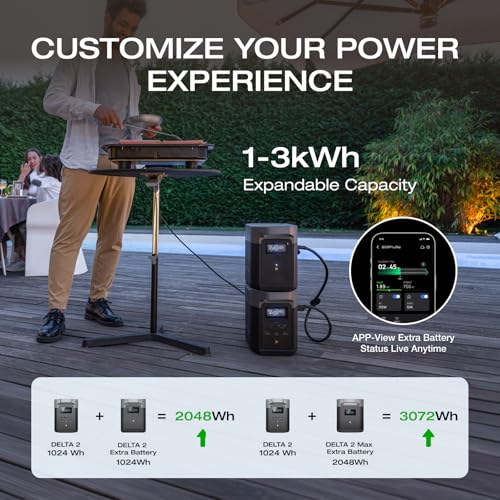
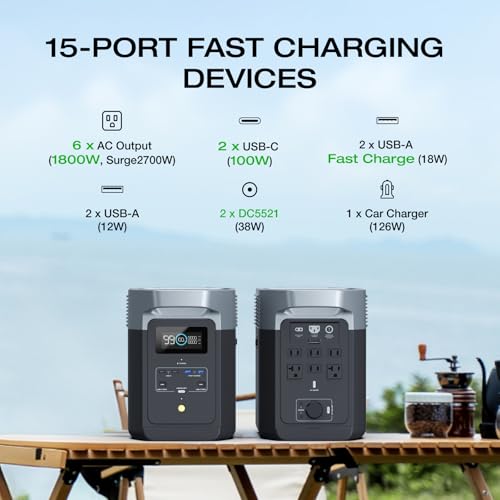
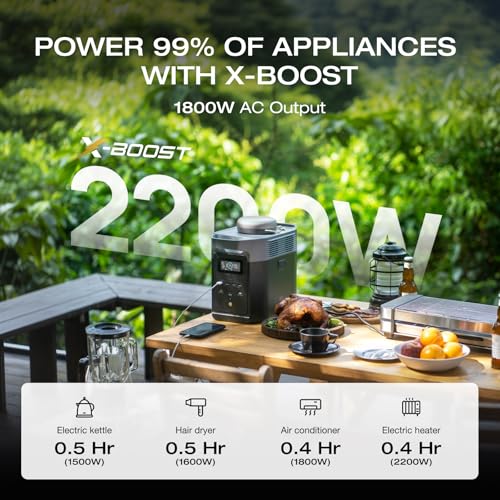
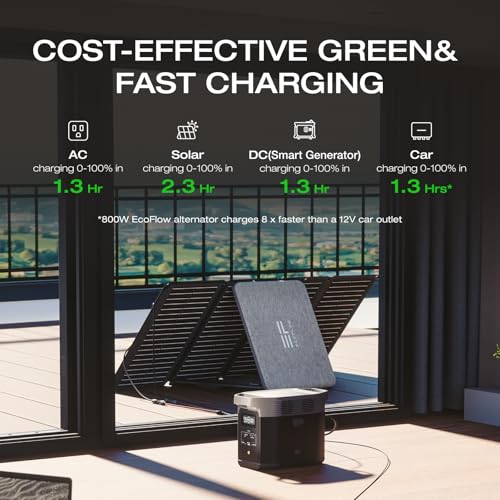
Photos from the Amazon listing we link. Some are EcoFlow’s own graphics.
Specifications
- Battery
- 1,024 Wh at 51.2 V, LiFePO4 (about 870 Wh usable) manual
- Output
- 1,800 W pure sine wave, 120 V; 2,700 W peak manual
- X-Boost
- Lets heating appliances up to 2,200 W run, held to 1,800 W manual
- Wall charge
- 1,200 W; 0–80% in 50 min, full in 80 min EcoFlow
- Solar
- 500 W max, 11–60 V, 15 A manual
- Car charging
- 12 V or 24 V socket, 8 A by default manual
- Extra battery
- One; up to 3,072 Wh in all extra batteries page
- Cycle life
- 3,000 cycles to 80%+ capacity manual
- Runs in
- 14–113°F; charges at 32–113°F manual
- Size and weight
- 15.7 × 8.3 × 11.1 in; 26.5 lb (12 kg) manual
- Warranty
- 5-year warranty EcoFlow
Pass-through: while it charges from the wall, the outlets run from the grid, not the battery. With nothing plugged in and the outlet buttons off, it turns itself off after 2 hours (you can change this in the app).
What reviewers found
Fan noise is the main complaint. We do not test units ourselves; these testers did.
- PCWorld measured 57 dBA three feet away when the fans ran at full speed while charging at 1,200 W. PCWorld review
- PCWorld found the fans start once you use more than about 120 W. PCWorld review
- Portable Power Lab found the fan rarely runs at CPAP-size loads (30-45 W), and reads 48-55 dB at full load. Portable Power Lab review
Which DELTA is which
EcoFlow sells several boxes with the same 1,024 Wh battery and similar names. Read the model name on the label on the unit, not on the box or the listing.
Compare the five look-alikes
| Model | Battery | Output | Peak | Extra batteries |
|---|---|---|---|---|
| EcoFlow DELTA 2 (EFD330) | 1,024 Wh | 1,800 W | 2,700 W | One; up to 3,072 Wh |
| EcoFlow DELTA 3 Plus | 1,024 Wh | 1,800 W | 3,600 W | Yes, via XT150 port; expandable up to 5 kWh total |
| EcoFlow DELTA 2 Max | 2,048 Wh | 2,400 W | 4,800 W | Up to 2 extra batteries, 6,144 Wh total |
| EcoFlow DELTA 3 Classic (1024Wh) | 1,024 Wh | 1,800 W | 3,600 W | Not listed by EcoFlow |
| EcoFlow DELTA 3 | 1,024 Wh | 1,800 W | 3,600 W | Yes, up to 5 kWh with an EcoFlow Extra Battery |
Buying the right one
The Amazon listing we link (ASIN B0B9XB57XM) is the bare DELTA 2: its title states 1,024 Wh and 1,800 W, the maker’s figures. Checked October 3, 2026. Searching for this model also returns bundles and other DELTA models.
Recall check: we have not yet screened this model against the CPSC recall list. Search it yourself: CPSC recall search.
Listings we did not link, and why
| Listing | Why not |
|---|---|
| EF ECOFLOW Portable Power Station Delta 3 Classic, 1024Wh 1800W AC | Listing title does not contain the model name 'DELTA 2'. |
| EF ECOFLOW Portable Power Station 3600Wh DELTA Pro, 120V 3600W AC Output | Listing title does not contain the model name 'DELTA 2'. |
| EF ECOFLOW Delta 3 Portable Power Station, 1024Wh 1800W | Listing title does not contain the model name 'DELTA 2'. |
| EF ECOFLOW DELTA 2 Max Power Station Extra Battery, 2048Wh LiFePO4 Battery | Listing is the 'DELTA 2 Max' variant, which is a different product from the 'DELTA 2' the maker lists. |
| EF EcoFlow Delta 2 Max Portable Power Station with 800W Alternator Charger | Listing is a bundle (solar panel or kit), not the bare base unit our specifications describe. |
Sources
Read October 1, 2026: EcoFlow DELTA 2 product page; EcoFlow DELTA 2 user manual (PDF); EcoFlow Smart Extra Batteries page; PCWorld DELTA 2 review; Portable Power Lab DELTA 2 review; Power Station Advisor: DELTA 2 vs DELTA 2 Max. Amazon prices checked October 3, 2026 (station) and October 3, 2026 (extra battery). Hours of use follow our method: typical appliance draws and 85% of the battery size.
Judged in: Which EcoFlow power station should you buy? (every EcoFlow model compared).
Compare it with its rivals
Anker SOLIX F3800 vs F3800 Plus: what the Plus adds for home backup · EcoFlow DELTA Pro 3 vs Anker F3800 vs Jackery 5000 Plus: which to buy · How long a power station runs a refrigerator