Anker SOLIX C1000
The Anker SOLIX C1000 is a 1,056 Wh portable power station with 1,800 W of outlets. On one charge it runs a typical fridge about 11 hours, a CPAP about 16 hours, or a fridge, Wi-Fi, lights and phones together about 6.9 hours.
$524 per usable kWh at Amazon prices checked October 3, 2026 ($470 for 898 usable Wh). Each added Anker SOLIX BP1000 Expansion Battery: $423 per usable kWh. How we work it out
Amazon links here are affiliate links: we may earn a commission, at no cost to you. It does not change our numbers. How that works.
Price checked October 3, 2026; Amazon shows today’s price. This is the listing we matched to the bare unit, not a bundle.
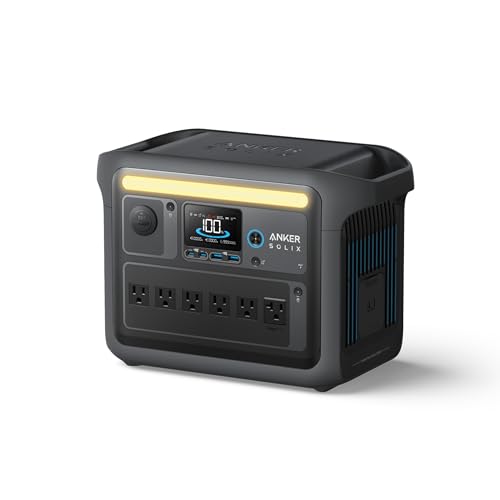
1,056 Wh battery (898 usable)1,800 W output2,400 W peak28.4 lb
- Extra battery
- One Anker SOLIX BP1000 Expansion Battery, 1,056 Wh: 2,112 Wh in all. $380 on Amazon. Details
- Wall charge
- 1,300 W with UltraFast on: 80% in 43 minutes
- Solar
- Up to 600 W, 11–60 V. Panels
- As a UPS
- Switches to battery in 20 ms. Details
Not the C1000 Gen 2: which one to buy. We compile maker specs and published tests; we did not test this unit.
C1000 or C1000 Gen 2?
Most people: the C1000. On October 3, 2026 it cost $470 on Amazon, $30 less than the Gen 2 ($500). That is $524 per usable kWh against $574. It also takes one extra battery; the Gen 2 takes none (Anker). Anker’s own advice: “For users who need expandable capacity, C1000 is recommended” (Anker).
Buy the Gen 2 if you need 2,000 W at once instead of 1,800 W, a 10 ms UPS switch instead of 20 ms (Anker), or a lighter box: 24.9 lb against 28.4 lb.
Side by side: 8 differences
| What | C1000 | C1000 Gen 2 |
|---|---|---|
| Battery | 1,056 Wh | 1,024 Wh |
| Output | 1,800 W | 2,000 W |
| Extra battery | One BP1000, to 2,112 Wh | Cannot add one |
| Full wall charge | 58 min (Anker) | 49 min (Anker) |
| UPS switch | 20 ms | 10 ms |
| Light bar | Yes | No |
| Weight | 28.4 lb | 24.9 lb |
| Amazon, October 3, 2026 | $470; $524/usable kWh | $500; $574/usable kWh |
From the table on Anker’s Gen 2 page, which compares the two.
C1000X? Anker’s user guide covers the C1000 and C1000X as one model, A1761 (Anker guide). Some stores also sell a version of the Gen 2 as the C1000X (The Solar Lab). Check the battery size: 1,056 Wh is this one, 1,024 Wh is the Gen 2. Every Anker model: which Anker SOLIX to buy.
How long it runs each appliance
A typical fridge runs about 11 hours: 2.6 hours for an old one working hard, up to 45 for an efficient one. It may not start a hard-starting fridge.
A CPAP at a typical 55 W runs about 16 hours, two nights of 8 hours. Power stations for a CPAP. Camping: a 12 V compressor cooler runs about 48 hours from the car socket. OutdoorGearLab ran an electric cooler, lights and devices on it for several days (OutdoorGearLab).
A sump pump runs about 6.6 hours, but its 2,400 W peak may not start a hard-starting pump. Anker says the 2,400 W SurgePad works best with heaters (Anker guide).
Chart: hours for 8 common appliances
The same numbers as a table
| Appliance | Typical average draw | Hours on one charge |
|---|---|---|
| Fridge | 84 W | about 11 h (may not start a hard-starting one) |
| Furnace blower, older (PSC) | 182 W | about 4.9 h (may not start a hard-starting one) |
| Furnace blower, variable-speed (ECM) | 132 W | about 6.8 h |
| CPAP | 55 W | about 16 h |
| Sump pump | 136 W | about 6.6 h (may not start a hard-starting one) |
| Wi-Fi router and modem | 24 W | about 37 h |
| Laptop | 52 W | about 17 h |
All 13 appliances, with starting watts and ranges
| Appliance | Running / starting | Starts it? | Typical | Range |
|---|---|---|---|---|
| Wi-Fi router and modem | 15–40 W | starts it | about 37h | 22–60h |
| Phone charging and small USB devices | 10–40 W | starts it | about 130h | 37–449h |
| A few LED lights | 15–80 W | starts it | about 60h | 15–239h |
| Laptop and monitor | 45–150 W | starts it | about 17h | 6–50h |
| CPAP | 30–100 W | starts it | about 16h | 9–30h |
| Refrigerator/freezer | 100–700 W
starts at up to 2,900 W |
may not start a hard-starting one | about 11h | 2.6–45h |
| Chest freezer | 80–500 W
starts at up to 2,200 W |
starts it | about 17h | 4–75h |
| Sump pump | 700–1,500 W
starts at up to 4,500 W |
may not start a hard-starting one | about 6.6h | 1.7–26h |
| Microwave | 800–1,800 W | starts it | about 30 minutes of running time | short bursts |
| Coffee maker | 700–1,500 W | starts it | about 36 minutes of running time | short bursts |
| Television | 40–250 W | starts it | about 16h | 3.6–75h |
| Garage door opener | 300–800 W
starts at up to 1,800 W |
starts it | about 67 minutes of running time | short bursts |
| 12 V compressor fridge (camping) | 25–110 W
starts at up to 320 W |
starts it | about 48h | 16–144h |
Typical is the middle of our range for that appliance. The range runs from a hard-working unit to an efficient one. Microwave, coffee maker and garage door show minutes of running time, because they run in short bursts.
C1000 vs Gen 2, Jackery 1000 v2 and DELTA 3
All four hold about 1 kWh, so they run a night of essentials for about the same hours. The price per usable kWh is what differs.
The same numbers as a table
| Setup | Wh | Essentials | Amazon | Per usable kWh |
|---|---|---|---|---|
| C1000 + BP1000 (sold together) | 2,112 | 14 hours | $800 | $446 |
| Anker SOLIX C1000 | 1,056 | 6.9 hours | $470 | $524 |
| Jackery Explorer 1000 v2 | 1,070 | 7 hours | $499 | $549 |
| Anker SOLIX C1000 Gen 2 | 1,024 | 6.7 hours | $500 | $574 |
| EcoFlow DELTA 3 | 1,024 | 6.7 hours | $599 | $688 |
The Jackery Explorer 1000 v2 is lighter (23.8 lb) but gives 1,500 W, takes 400 W of solar and no extra battery. The EcoFlow DELTA 3 costs more per kWh. It takes EcoFlow extra batteries, up to 5 kWh with an EcoFlow Extra Battery.
Per usable kWh = Amazon price ÷ 85% of the battery size. Prices checked October 3, 2026.
Questions buyers ask
Which extra battery fits? Is the BP1000 on Amazon?
The Anker SOLIX BP1000 Expansion Battery, 1,056 Wh (Anker guide). It takes one, for 2,112 Wh in all (Anker guide). On October 3, 2026 the bare pack cost $380 on Amazon: $423 per usable kWh, against $524 for the C1000 itself. Amazon also sells the C1000 and BP1000 together for $800, $50 less than buying both apart ($850). With it, a typical fridge runs about 21 hours and a night of essentials about 14 hours. It does not fit the Gen 2 (Anker). Extra batteries for every station.
What solar panels can it use?
Up to 600 W from up to two panels (Anker guide), into an XT-60 port at 11–60 V. It takes 10 A at 11–32 V and 12.5 A at 32–60 V (Anker guide). Keep the panels’ open-circuit voltage (Voc) under 60 V. Anker says 600 W refills it in 1.8 hours (Anker); real panels give less than their rating. It does not charge from the wall and solar at once: the wall goes first (Anker). Which panels fit.
How long does it take to charge?
From the wall it takes 1,000 W normally (Anker guide) and 1,300 W with UltraFast turned on in the app (Anker guide). Anker says 80% in 43 minutes and full in under an hour (Anker). OutdoorGearLab measured 88 minutes normally and 65 with UltraFast (OutdoorGearLab; OutdoorGearLab). Anker suggests the normal speed unless you need it fast (Anker guide).
Can it work as a UPS, and while it charges?
Yes. Plug the C1000 into the wall and your devices into its AC outlets (Anker guide). If the power goes out, it switches to battery in 20 ms (Anker guide). The Gen 2 switches in 10 ms. OutdoorGearLab lists it as UPS capable (OutdoorGearLab). While it charges from the wall with the outlets on, the wall input goes up to 1,440 W (Anker guide), and the 2,400 W SurgePad is off (Anker guide).
More questions: weight, cold, storage, warranty, manual
How heavy is it?
28.44 lb (12.9 kg), 14.8 × 8.07 × 10.5 in (Anker; Anker guide). OutdoorGearLab weighed 28.65 lb (OutdoorGearLab). The Gen 2 weighs 24.9 lb (Anker).
Can it run in the cold?
It runs from −4°F to 104°F (Anker guide) but only charges from 32°F to 104°F (Anker guide).
How do I store it?
Anker says to check it each week, charge it if it drops below 30%, and charge it to 100% every 3 months (Anker guide). It turns itself off after 12 hours with the outputs off and nothing plugged in (Anker guide).
What is the warranty?
Five years (Anker). Anker rates the battery for 3,000 cycles to 80% (Anker).
Where is the manual?
Anker’s user guide is a PDF: C1000/C1000X user guide. It lists every port, the solar limits and the UPS time.
What testers found
We do not test units ourselves. These testers did.
- OutdoorGearLab (Kenji Mowrey and Sentry Kelly, review) got 897 Wh out of the 1,056 Wh battery (OutdoorGearLab), close to the 898 Wh we plan on. At full output it ran 33 minutes (OutdoorGearLab). Its fan was one of the loudest they tested at full load (OutdoorGearLab). There is no setting to stop charging at, say, 80% (OutdoorGearLab). They now point buyers to the Gen 2 (OutdoorGearLab).
- The Solar Lab tested the Gen 2: a full charge in about 47 minutes (The Solar Lab) and about 13.8 W idle (The Solar Lab). It has no working light (The Solar Lab); the C1000 has a light bar and an SOS mode (Anker guide).
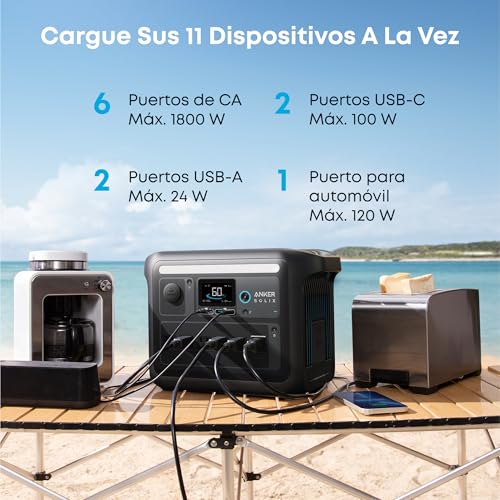
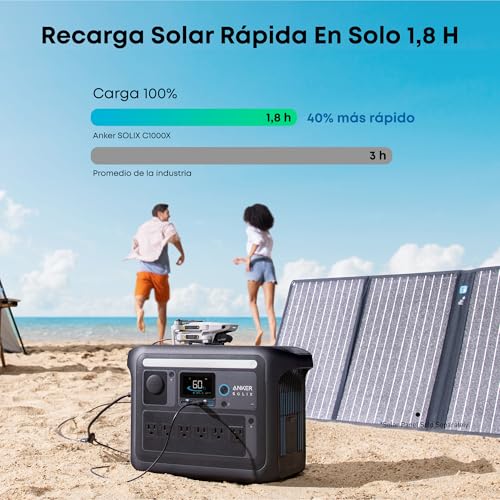
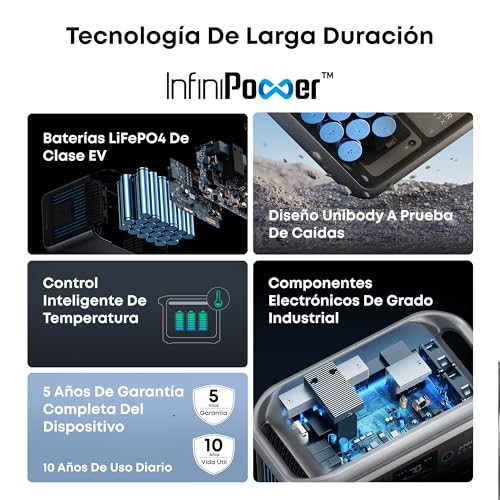
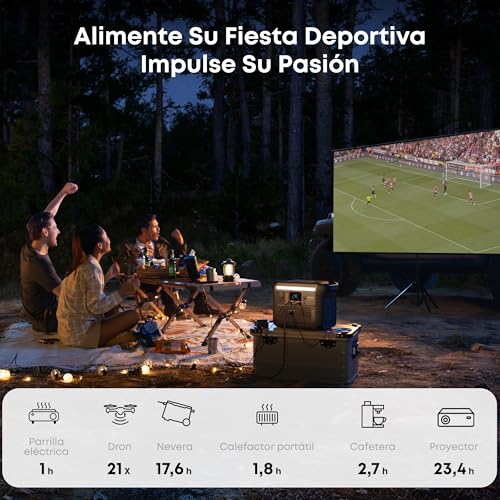
Photos from the Amazon listing we link (the black version). Some are Anker’s own graphics, in Spanish.
Specifications
All 13 specifications, with sources
- Model
- A1761 (C1000 and C1000X) Anker guide
- Battery
- 1,056 Wh LiFePO4 (about 898 Wh usable) Anker
- Output
- 1,800 W pure sine wave, 120 V; 2,400 W surge (SurgePad) Anker guide
- Outlets
- 6 AC; 2 USB-C (100 W and 30 W, output only); 2 USB-A (12 W); car socket (12 V, 10 A): 11 ports Anker guide
- Wall charge
- 1,000 W; 1,300 W with UltraFast; 1,440 W input while passing power through Anker guide
- Solar
- 600 W, 11–60 V, XT-60; 10 A up to 32 V, 12.5 A above Anker guide
- Extra battery
- One BP1000 (1,056 Wh), 2,112 Wh in all Anker guide
- UPS switchover
- 20 ms Anker guide
- Battery life
- 3,000 cycles to 80% Anker
- Light
- Light bar with 3 levels and SOS Anker guide
- Runs in
- −4–104°F; charges at 32–104°F Anker guide
- Size and weight
- 14.8 × 8.07 × 10.5 in; 28.44 lb (12.9 kg) Anker guide
- Warranty
- 5 years Anker
Buying the right one
We link the bare C1000 in black (ASIN B0GR9H79KS, model A1761, checked October 3, 2026). Search results also show the Gen 2, kits with panels or a bag, and the C1000 sold with its extra battery.
Recall check: no CPSC recall names the C1000 (model A1761) in our screen of October 1, 2026. That cannot clear your own unit. Check the model and serial number on its label with Anker (Anker recall lookup) or the CPSC recall search. Anker’s recalled power banks (A1263, A1642, A1647, A1652) have model numbers that also start with A1; they are not this unit.
Listings we did not link, and why
| Listing | Why not |
|---|---|
| Anker SOLIX C1000 Gen 2 Portable Power Station | Listing is the 'C1000 Gen' variant, which is a different product from the 'C1000' the maker lists. |
| Anker SOLIX C1000 Gen 2 Portable Power Station, 2,000W (Peak 3,000W) Solar Gener | Listing is the 'C1000 Gen' variant, which is a different product from the 'C1000' the maker lists. |
| Anker SOLIX C1000 Portable Power Station and 100W Bifacial Panel, 1,056Wh | Listing is a bundle (solar panel or kit), not the bare base unit our specifications describe. |
| Anker SOLIX C1000 Gen 2 Portable Power Station with 200W Solar Panel | Listing is a bundle (solar panel or kit), not the bare base unit our specifications describe. |
| Anker SOLIX C1000 Power Station and BP1000 Expansion Battery, 2112Wh, 1800W | Listing is a bundle (solar panel or kit), not the bare base unit our specifications describe. |
Sources: 5 pages, read October 1, 2026
Anker SOLIX C1000 page; Anker SOLIX C1000/C1000X user guide, US (PDF copy); Anker SOLIX C1000 Gen 2 page (with Anker's Gen 2 vs C1000 table); OutdoorGearLab: Anker Solix C1000 review; The Solar Lab: C1000 Gen 2 and C1000X review. Amazon prices checked October 3, 2026 (stations) and October 3, 2026 (BP1000). Hours of use follow our method: typical appliance draws and 85% of the battery size.
Every Anker model: which Anker SOLIX to buy · best power station for camping.
Judged in: Which Anker SOLIX power station should you buy? (every Anker SOLIX model compared); The best portable power stations for camping.